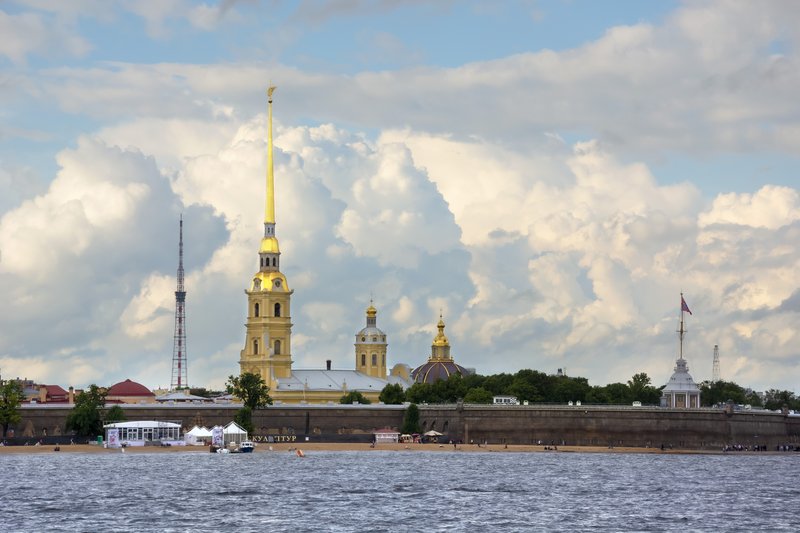
Peter the Great laid the first bastion on this flat island in the Neva and the city grew out from it; inside the walls the cathedral's gilded spire still carries the tallest Orthodox bell tower in the world, and almost every Romanov ruler from Peter I onward is buried beneath it.
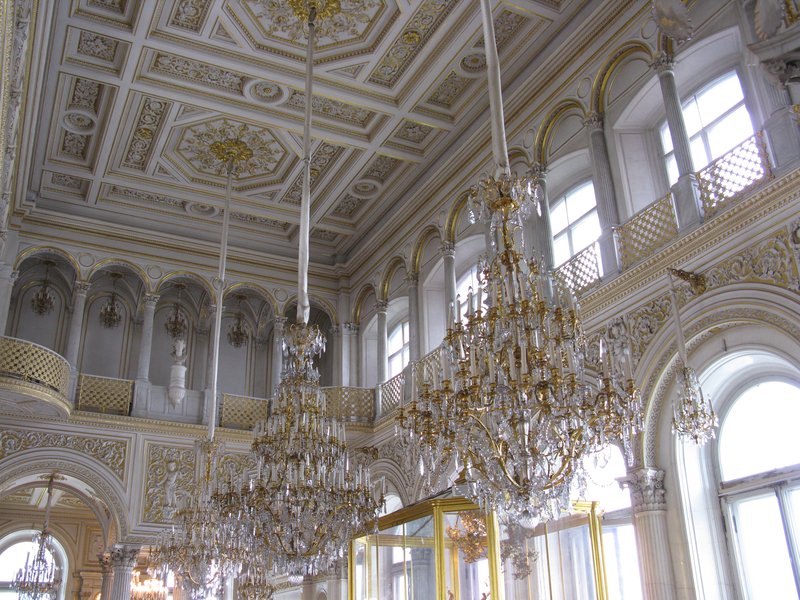
Catherine the Great's private collection grew into roughly three million works spread through the Winter Palace and four buildings beside it, so a visit is two things at once — Rembrandt, Titian and da Vinci on the walls, and the tsars' own state rooms, malachite halls and parquet around them.
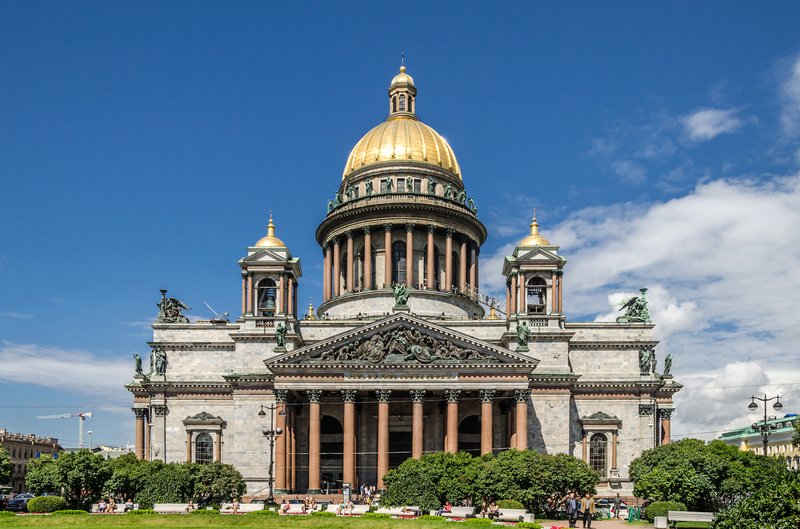
Forty years of building left a gilded dome 101.5 m up on granite columns quarried whole, and an interior lined in malachite, lapis and coloured marble; the reason to climb, though, is the open colonnade that rings the drum, which puts the whole low, flat centre of the city under you at once.
24 min · 8 min → Church of the Savior on Spilled Blood
4.Church of the Savior on Spilled Blood~1 hr
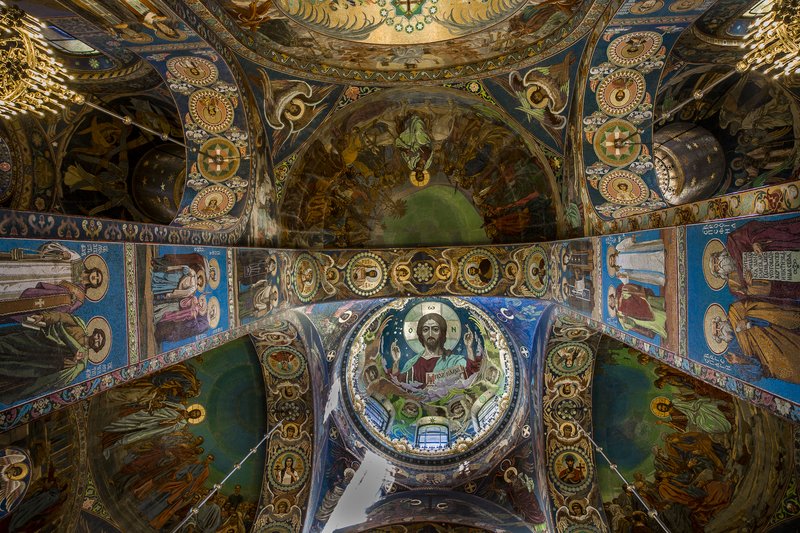
Built on the spot where Alexander II was assassinated, this is the one building in the city that refuses the imperial grey-and-gold palette — onion domes outside, and inside almost every surface from floor to vault covered in mosaic rather than paint, which is why the ceiling repays as much time as the walls.
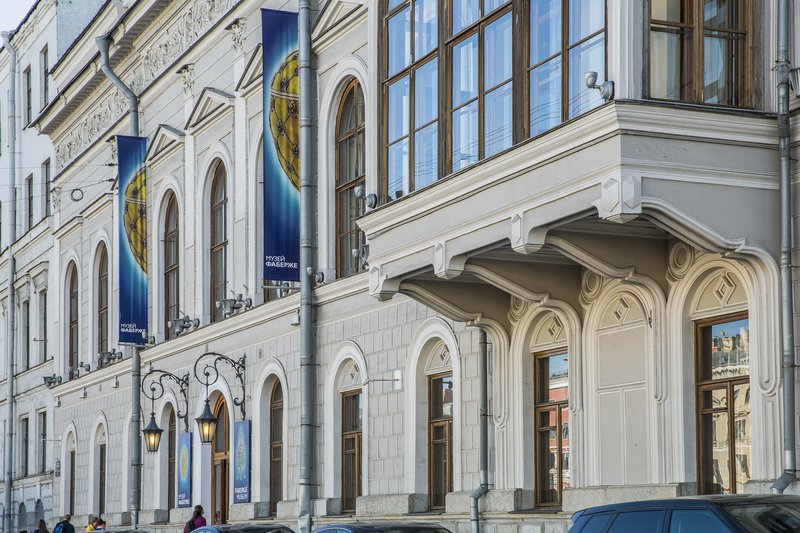
Viktor Vekselberg bought back nine of the Imperial Easter eggs Fabergé made for the last two tsars and installed them, with roughly 4,000 more pieces of the workshop's gold, enamel and silver, inside the restored Naryshkin-Shuvalov Palace on the Fontanka — close enough to read the hinges and hidden surprises inside each egg.
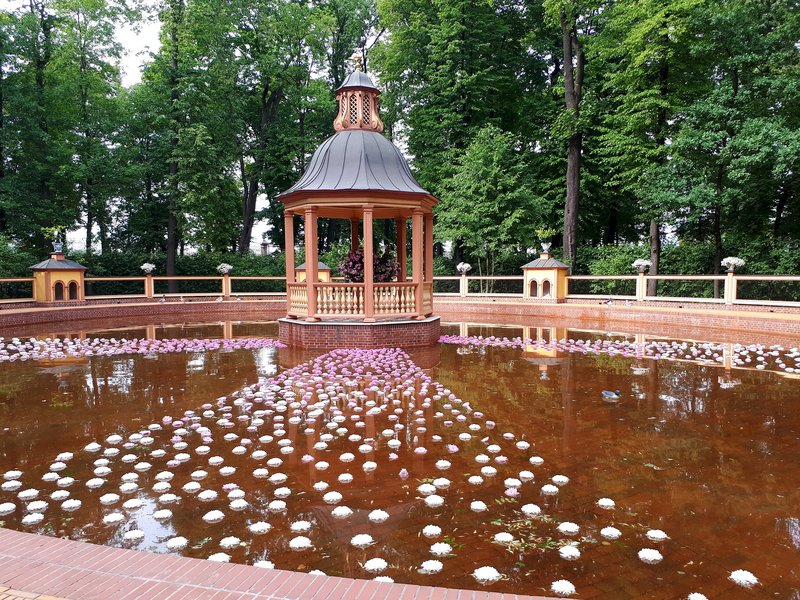
Peter the Great laid out his own garden on this spit between the Neva and the Fontanka in 1704, and Jean-Baptiste Le Blond's formal plan of allées and roughly a hundred marble statues survives even though the originals now stand indoors and copies take the weather — the oldest planned green space in the city.
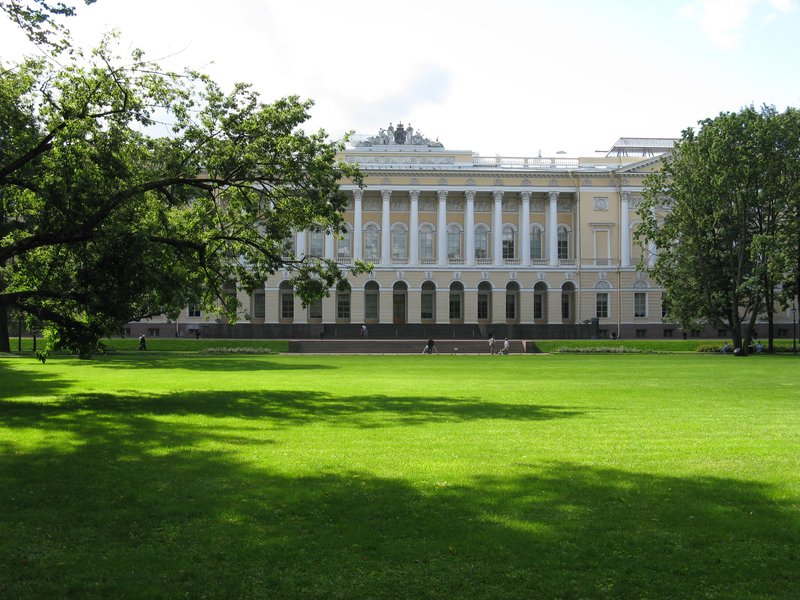
Nicholas II opened Carlo Rossi's Mikhailovsky Palace as a museum of Russian art alone in 1898, and the nationalisations that followed 1917 handed it pieces like Malevich's Black Square; the collection now runs from medieval icons through the folk and avant-garde traditions the Hermitage's Western-facing galleries never covered.
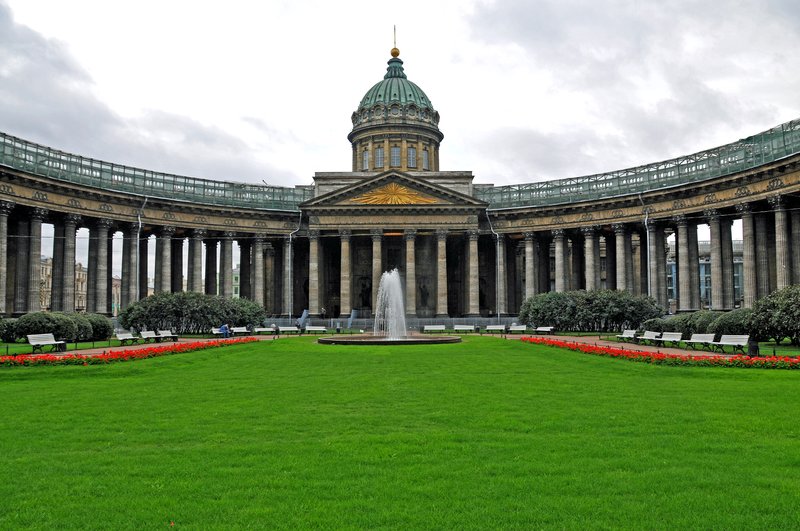
Andrey Voronikhin modelled the semicircular colonnade on St Peter's Basilica in Rome, and after 1812 the building doubled as a war memorial — Mikhail Kutuzov is buried inside, entombed there in thanks for the campaign that broke Napoleon's invasion, and captured French banners once hung from these same walls.
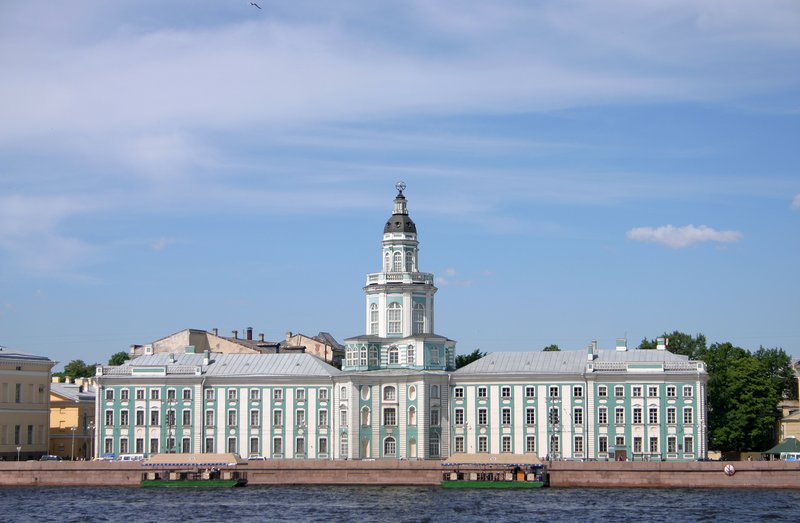
Peter the Great founded Russia's first museum in 1714 to house his own cabinet of curiosities, and the building on the Strelka still keeps its 18th-century collections of anatomical specimens and ethnographic material gathered from across the Russian Empire and beyond — a scholarly, sometimes unsettling counterpoint to the palaces on the other bank.
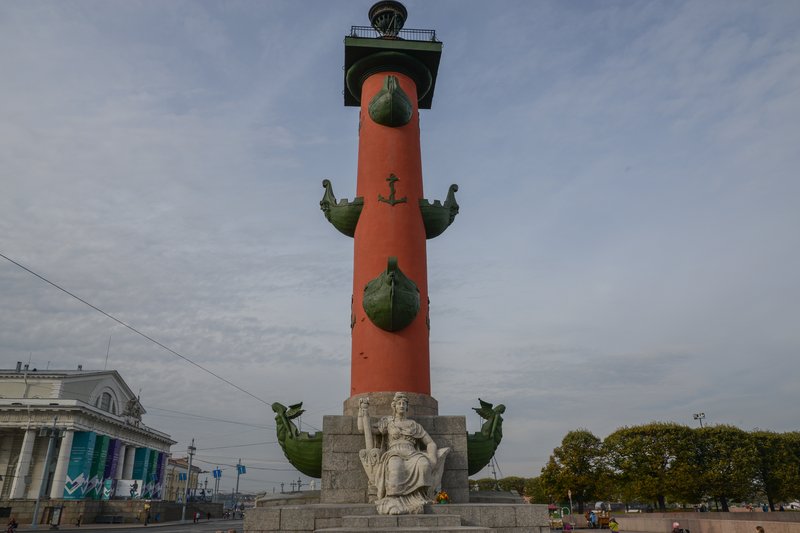
Thomas de Thomon raised the two Rostral Columns in 1810 as working lighthouses for the river port that once worked this spit, their bases ringed with ships' prows cast in the naval tradition that gives them their name. The terrace between them is the single widest view in the city, taking in the Winter Palace, the fortress and the Neva splitting around the island at once.
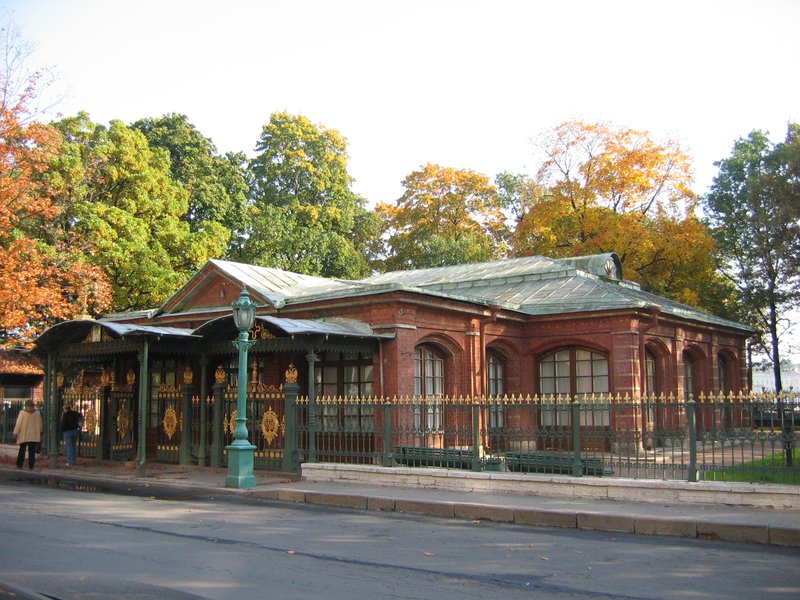
Soldiers built Peter's first Petersburg residence from pine logs in three days in May 1703, and Catherine II later encased the little house inside a protective brick and glass shelter to keep it standing. Inside, three small rooms hold furniture and personal effects that put the founder of this city on an oddly human scale.
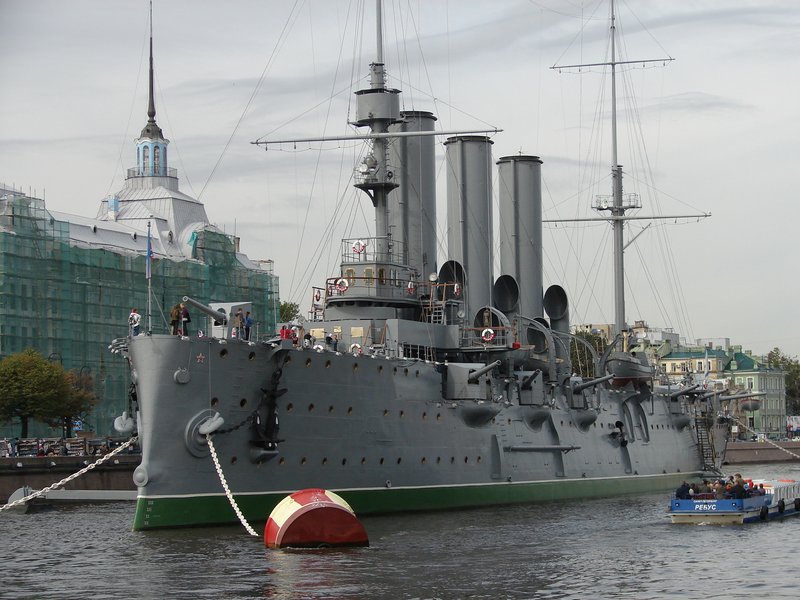
The cruiser's forward gun fired the blank shot on the night of 25 October 1917 that signalled the assault on the Winter Palace, and the ship had already survived the disastrous Battle of Tsushima against Japan in 1905. It has sat moored on this stretch of the Petrogradskaya embankment as a museum since 1957, its wartime and revolutionary history laid out across the original decks.
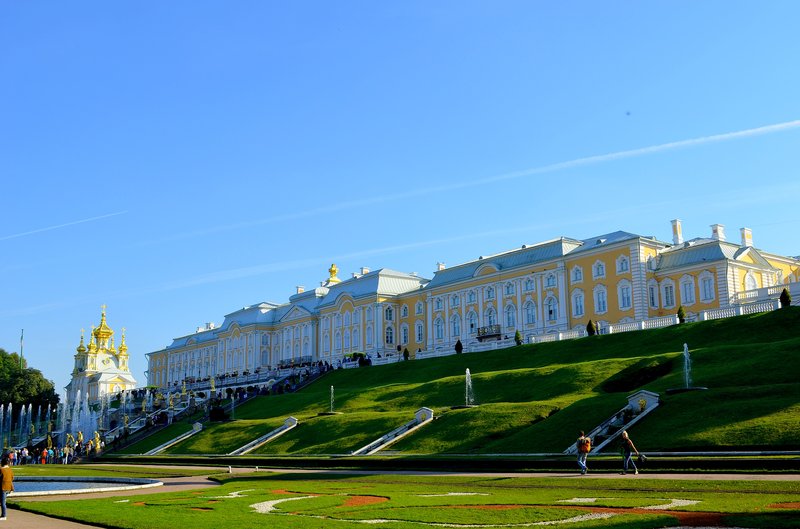
Peter the Great began this seaside palace in 1714 as his answer to Versailles, and successive tsars — above all Empress Elizabeth, through Rastrelli's 1750s remodel — expanded it into a 300-room baroque set piece. The state rooms and the Great Hall's mirrored ballroom were rebuilt from wartime photographs after the German occupation gutted the palace in 1944.
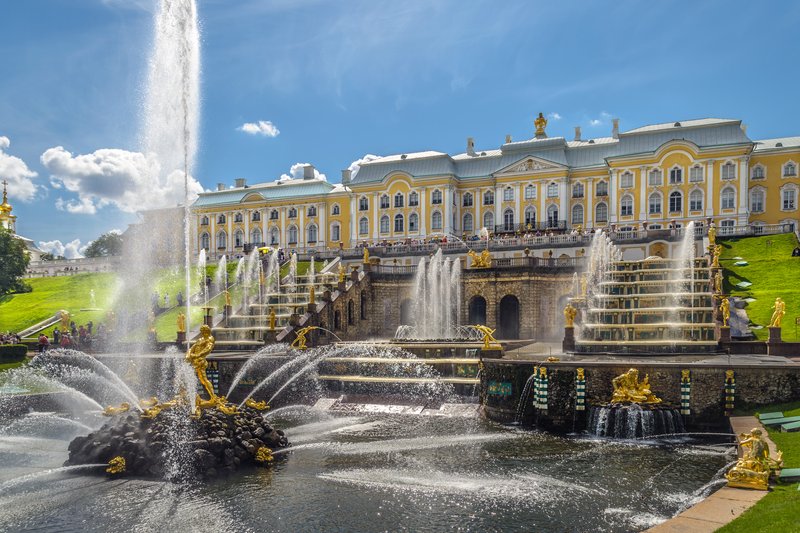
Sixty-four fountains and 225 gilded statues run on gravity alone, fed by natural springs 22 km away with no pumps anywhere in the system — Peter's engineers solved the water pressure with elevation, not machinery. The centrepiece, Samson tearing open a lion's jaws, marks Russia's win over Sweden at Poltava in 1709.
ARRIVE Detskoye Selo: 35 min · 9 min → Catherine Palace
1.Catherine Palace~1 hr 30 min
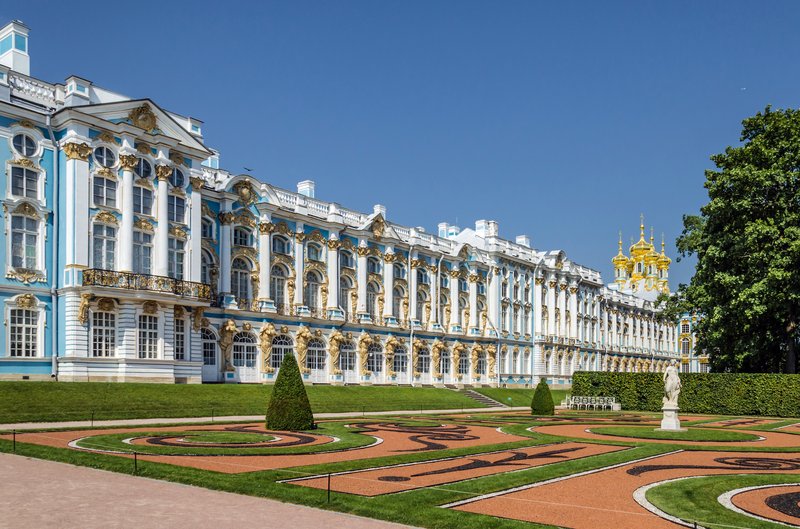
Empress Elizabeth had Bartolomeo Rastrelli rebuild her mother's country house into a 325-metre baroque facade of blue, white and gold, and every State Room inside survives from Catherine the Great's own remodelling. The Amber Room — six tons of amber panels the Nazis looted in 1941 and lost for good — was recreated from scratch over 24 years and reopened in 2003.
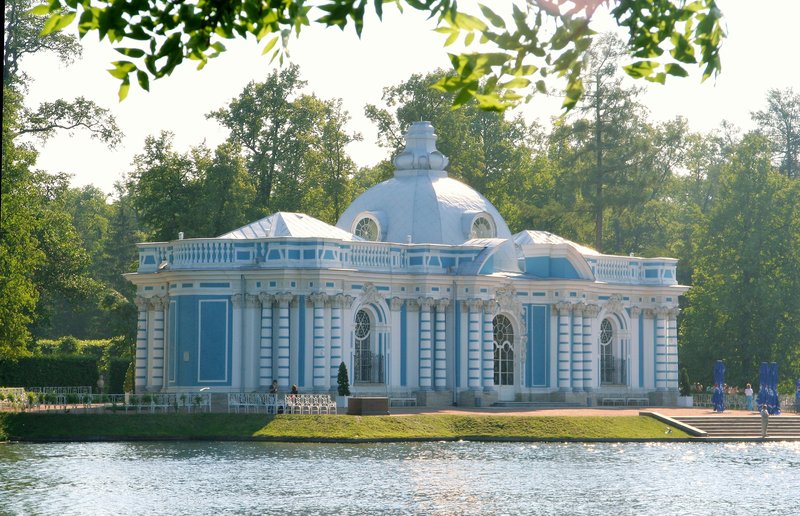
Catherine the Great commissioned an English-style landscape park to loosen the palace's formal French parterres into naturalistic lakes, follies and pavilions around the Great Pond — Rastrelli's ice-blue Hermitage pavilion and the domed Grotto on the water's edge give the park its quietest corners, away from the palace crowds.
State Museums · Closed Wednesday — the Saint Isaac's group and every Peter and Paul Fortress exhibition share one closing day, though the fortress island stays open
Imperial Museums & Palaces · Closed Monday
Art, Naval & Palace Museums · Closed Tuesday — the Russian Museum, Summer Garden, Peter the Great's Cabin, Catherine Palace and Cruiser Aurora all close this day
Ring doughnuts fried in the morning, buried in icing sugar and eaten standing up with sweet milky coffee. The Bolshaya Konyushennaya counter has served them the same way for decades and takes cash only.
Beef in a sour-cream and mushroom sauce, invented in this city in the kitchen of Count Stroganov and still cooked in its old dining rooms rather than treated as a museum piece.
Honey cake built from a dozen thin baked layers with sour-cream custard between them, left to soften overnight so it cuts like a sponge and tastes like caramel.
Foreign number: not accepted. — the sign-up form offers a foreign country code, but the confirmation SMS reaches Russian and CIS numbers reliably and a foreign one usually never receives it.
The only full-menu delivery app with real coverage across Saint Petersburg — most of the centre's restaurants are on it and delivery inside the historic core runs 30 to 45 minutes. Its weakness for a visitor is access rather than coverage: an order needs a Russian number to register and a Russian card to pay.
Foreign number: not accepted. — the country-code list accepts a foreign number but the confirmation SMS is sent through Russian carriers, so on a foreign carrier the code usually never lands.
Uber folded its Russian business into Yandex Go, so this is the ride app here rather than one of several — cars arrive within minutes anywhere in the historic centre and fares are low. The catch is registration and payment: it wants a Russian number and a Russian card.
Catherine the Great's son Paul built a neoclassical palace here in the 1780s, more restrained than his mother's at Tsarskoye Selo, set inside the largest English landscape park in Europe — quieter than its more famous neighbour, on the same rail line. Vitebsky station runs the trains to Pavlovsk.
A palace that reads as a castle rather than a summer residence — grey limestone, a parade ground, and an underground passage linking the cellars to a lake. Far quieter than the imperial-scale palaces. Lastochka trains use Baltiysky station.
The one imperial palace ensemble the German occupation never reached, so its Rococo interiors and the Chinese Palace's lacquered rooms survive unrestored and original rather than rebuilt after the fact. Baltiysky station runs the trains to Oranienbaum I.
A medieval Swedish castle on an island, a granite park of rock and pine at Monrepos, and a town centre that looks Nordic rather than Russian because for most of its history it was. Lastochka trains use Finlyandsky station.
The oldest city in Russia and the one that skipped the Mongol sack, so its St Sophia Cathedral and the kremlin walls around it are genuinely medieval rather than rebuilt. A long day, but the only one on this list that changes the story. Lastochka trains use Moskovsky station.
Saint Isaac's Cathedral — The colonnade is a separate ticket
The 200-step climb is sold apart from cathedral entry and keeps its own calendar — no closing day in summer, third Wednesday closed in winter.
State Hermitage Museum — Entry is by timed slot
The ticket is valid for the slot printed on it and that day only, and the ticket office stops selling a full hour before the museum closes.
Peter and Paul Fortress — Walls free but museums ticketed
Hare Island opens at 6:00am and costs nothing to walk; the cathedral and every exhibition inside need a ticket and shut on Wednesday.
Pyshki — Cash only
The Bolshaya Konyushennaya counter takes rubles in hand and nothing else, which catches out anyone relying on a card.
Worth Knowing
A city built to a plan, on ground that did not want one
Everything on this route stands on drained marsh. Peter the Great put the first bastion on Hare Island on land that flooded twice a year, and the whole centre was raised, piled and embanked into existence afterwards — which is why the streets run straight, the skyline stays low, and the ground under Saint Isaac's needed more than ten thousand timber piles before a single granite column went up.
The low skyline is not an accident of history either. For most of the imperial period no building was permitted to rise above the Winter Palace's cornice, so the domes and spires you pick out from the colonnade — the Admiralty, Peter and Paul, Saint Isaac's itself — are the only things breaking a deliberately flat roofline. It is the reason a 43 m walkway gives you the whole city rather than a view of the next block.
Two closing days govern a visit here and they do not agree. The Hermitage takes Monday; the Saint Isaac's museum group and every exhibition inside the Peter and Paul Fortress take Wednesday. A Wednesday arrival can still see the Hermitage and walk the fortress walls, but three of this guide's four interiors will be shut — the single most useful fact to check before booking a date.
Payment is the other thing that catches visitors out, and it is not about price. Cards issued outside Russia stopped working after the sanctions and have not come back, the Western booking and tour platforms no longer sell anything here, and app sign-ups verify by SMS to Russian numbers. Plan on cash in hand for tickets, doughnuts and taxis, and treat a local SIM as the thing that unlocks everything else.
The mosaics in the Church of the Savior on Spilled Blood are worth understanding before you stand under them: there is almost no paint in the building. Around 7,500 square metres of the interior is glass and stone tesserae, laid by the Frolov workshop over more than two decades, which is why the colours have not faded the way frescoes of the same age have — and why the light changes the room completely between a bright morning and a grey afternoon.