MEXICO CITY
Hilton Mexico City Reforma
Mexico
TRIP OVERVIEW
Day 1 – Catedral Metropolitana · Zócalo · Palacio Nacional · Templo Mayor
Day 2 – Palacio de Bellas Artes · Palacio Postal · Torre Latinoamericana · Alameda Central
Day 3 – Museo Nacional de Antropología · Castillo de Chapultepec · Bosque de Chapultepec · Museo Soumaya
Day 4 – Museo Frida Kahlo · Jardín Centenario & Plaza Hidalgo · Museo Anahuacalli · Xochimilco
Day 5 – Zona Arqueológica de Teotihuacán · Basílica de Guadalupe · Plaza de las Tres Culturas
Day 1
From Hotel: 22 min · 8 min → Catedral Metropolitana
1.Catedral Metropolitana~45 min
The largest cathedral in the Americas, built in stages over 250 years directly on top of a razed Aztec sacred precinct — its own foundations are sinking unevenly into the old lakebed, giving the floor a visible tilt. Five naves, sixteen chapels and a gilded main altar sit behind a Baroque-to-Neoclassical facade flanked by twin bell towers.
Catedral Metropolitana, Mexico City
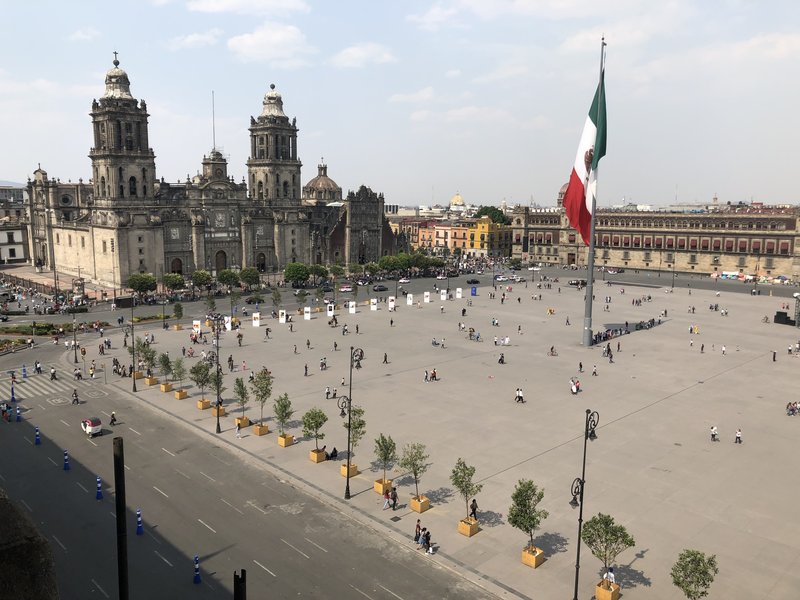
2.Zócalo~30 min
Mexico City's vast central square — one of the largest in the world — sits on the ruins of the Aztec capital Tenochtitlan and has been the ceremonial heart of the city since. The Cathedral, the National Palace and the excavated Templo Mayor all face onto it, and a monumental flag is raised and lowered here each day.
Plaza de la Constitución, Mexico City
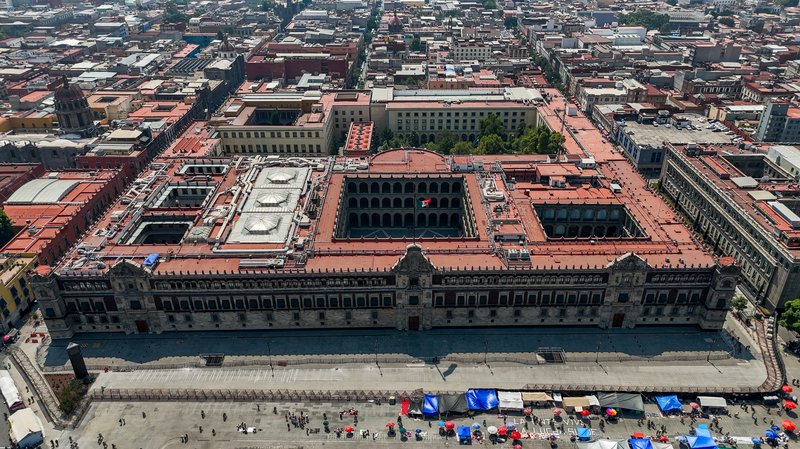
3.Palacio Nacional~1 hr
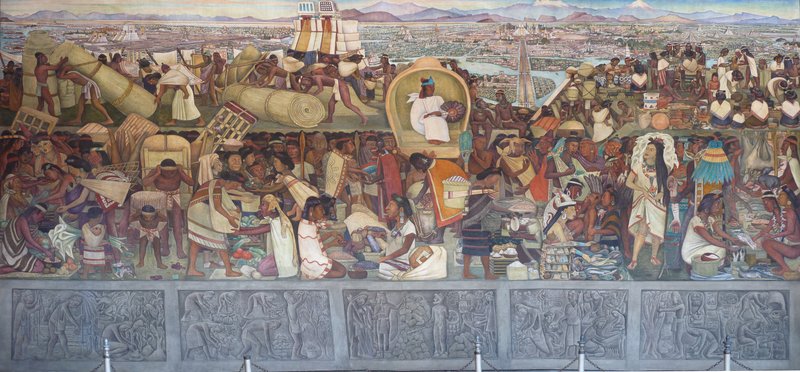
Mexico's seat of government since the Aztec emperor Moctezuma II's own palace stood on this ground. Inside, Diego Rivera's monumental mural cycle wraps the main staircase and upper corridors — a sweeping, decades-long history of Mexico from the pre-Columbian world through the Conquest to the twentieth century. Entry is by free guided tour with photo ID; there is no advance online booking.
Tuesday - Sunday 10:00am - 5:00pm
Closed Monday
Free
Diego Rivera mural, Palacio Nacional, Mexico City
4.Templo Mayor~1 hr 30 min
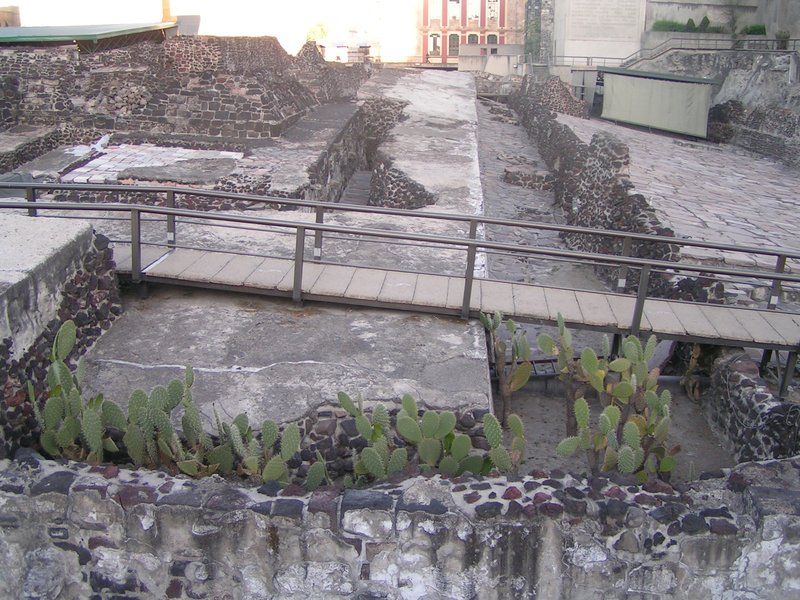
The primary temple of the Mexica capital Tenochtitlan, rediscovered by accident in 1978 when electrical workers hit a carved stone disc. Excavations exposed seven rebuilding phases of the twin pyramid dedicated to Huitzilopochtli and Tlaloc, right beside the Cathedral. The site museum displays the enormous Coyolxauhqui stone and thousands of ritual offerings recovered from beneath the plaza.
Museo del Templo Mayor · 4.6 · tiqets.com
Tuesday - Sunday 9:00am - 5:00pm
Closed Monday
Templo Mayor archaeological site, Mexico City
Calle Regina has good evening dining options
Day 2
From Hotel: 3 min · 3 min → Palacio de Bellas Artes
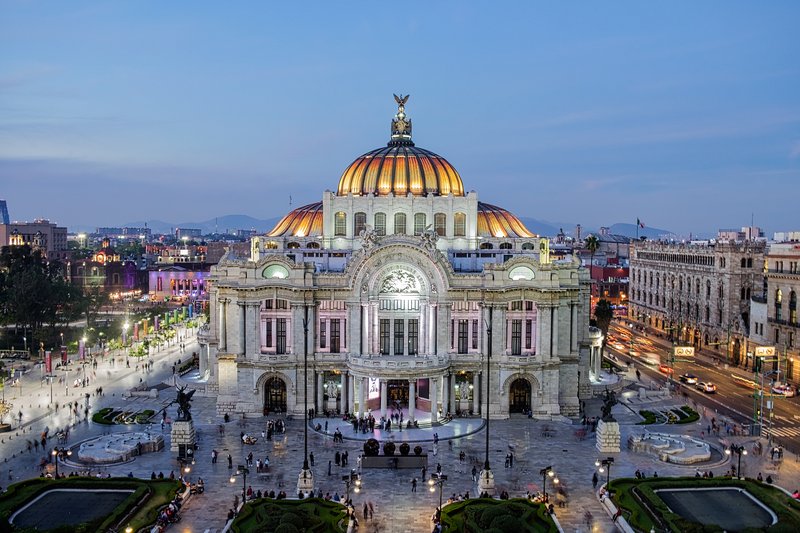
1.Palacio de Bellas Artes~1 hr 30 min
A white Carrara marble Art Nouveau shell built for the 1910 centennial, capped with a stained-glass dome, wrapped around an Art Deco interior finished decades later. The upper floors carry a major mural cycle — Diego Rivera's reconstructed "Man, Controller of the Universe" alongside works by Siqueiros, Orozco and Tamayo. It also remains Mexico's flagship opera and ballet house.
Palacio de Bellas Artes, Mexico City
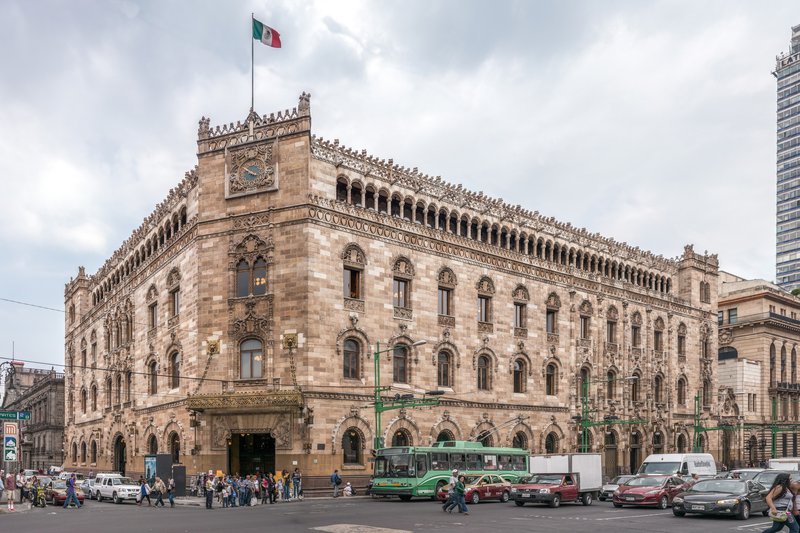
2.Palacio Postal~30 min
Mexico City's working central post office, opened in 1907 and still handling mail beneath a blend of Art Nouveau, Plateresque and Venetian Gothic detailing. Bronze-plated elevator cages, an onyx-and-marble staircase and gilded window grilles fill an interior that reads more like a palace than a post office — a small postal museum occupies the upper floor.
Monday - Friday 8:00am - 4:00pm · Saturday 8:00am - 12:00pm
Closed Sunday
Free
Palacio Postal, Mexico City
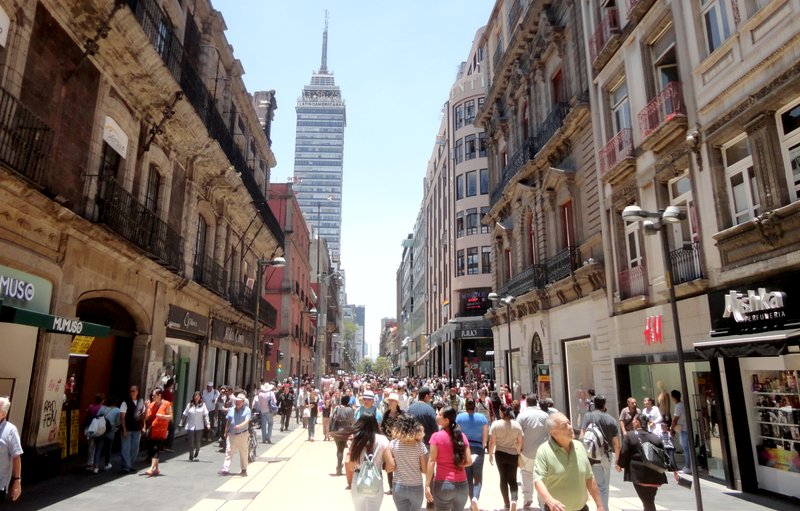
3.Torre Latinoamericana~1 hr
Latin America's tallest building when it opened in 1956, engineered on a deep floating foundation that let it ride out the 1957 and 1985 earthquakes essentially undamaged while buildings around it collapsed. The 44th-floor observation deck gives the best 360° panorama of the historic center, with the volcanoes Popocatépetl and Iztaccíhuatl visible on a clear day.
Torre Latinoamericana seen from Avenida Francisco I. Madero, Mexico City
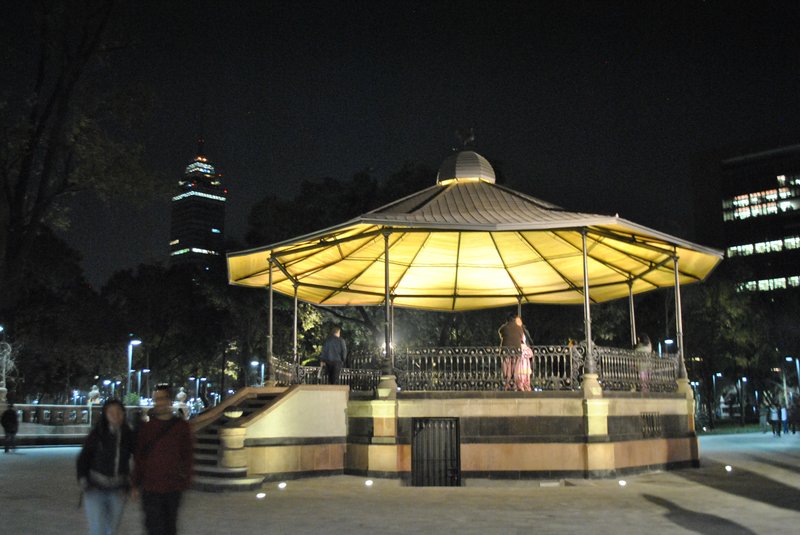
4.Alameda Central~30 min
The oldest public park in the Americas, laid out in 1592 on what was once an Aztec marketplace. Poplar trees — álamos, which give the park its name — shade marble fountains, wrought-iron benches and the white marble Hemiciclo a Juárez monument — a popular gathering spot since the 16th century and still the calmest stretch of green in the historic center.
Daily 6:00am - 10:00pm
Free
Alameda Central, Mexico City
Day 3
From Hotel: 12 min → Museo Nacional de Antropología
1.Museo Nacional de Antropología~2 hr
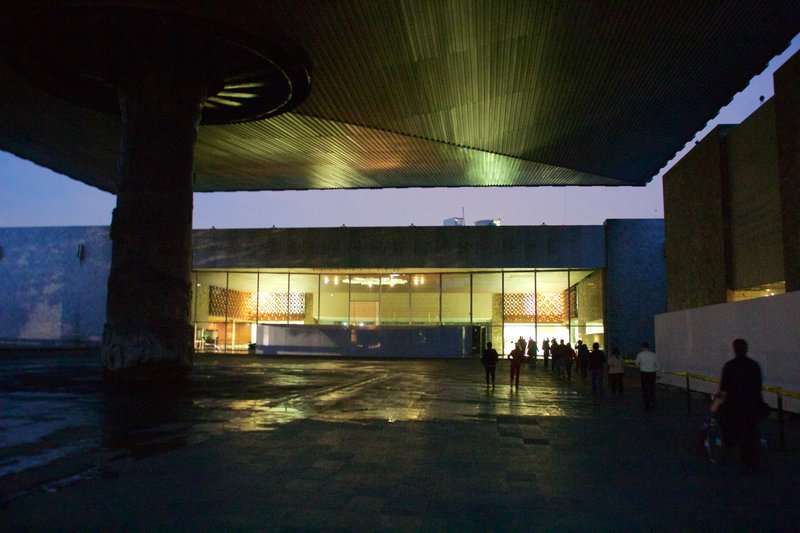
The definitive collection of pre-Columbian Mexico — 23 halls arranged around a courtyard beneath "El Paraguas," a vast concrete umbrella on one pillar with water cascading from its rim. The Aztec Sun Stone, the Olmec colossal heads and the Maya rooms alone justify a half-day; the halls upstairs cover Mexico's living indigenous cultures.
El Paraguas courtyard, Museo Nacional de Antropología, Mexico City
2.Castillo de Chapultepec~1 hr 30 min
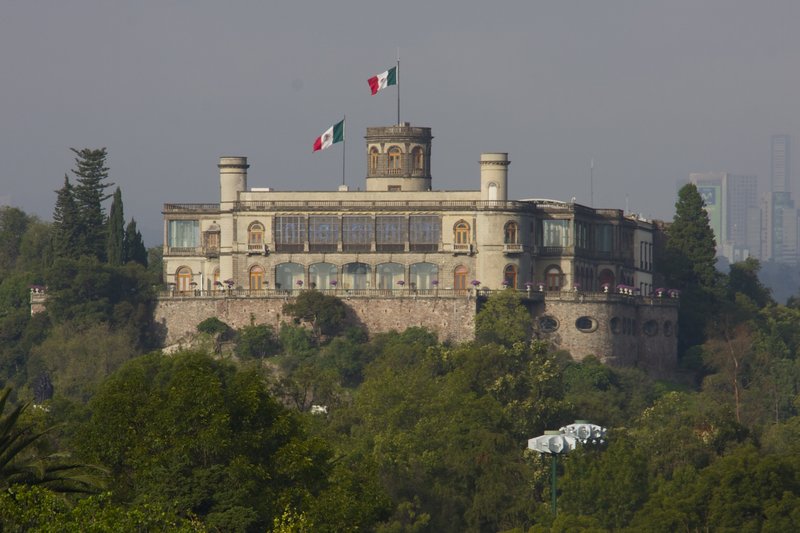
The only royal castle in North America, built on the hilltop where an Aztec temple once stood, later the residence of Emperor Maximilian I and Empress Carlota, then of Mexican presidents until 1939. It now houses the National History Museum — Diego Rivera and other muralists' work, imperial furnishings, and a colonnaded terrace overlooking Paseo de la Reforma.
Museo Nacional de Historia · 4.6 · tiqets.com
Tuesday - Sunday 9:00am - 5:00pm
Closed Monday
8 min uphill
Castillo de Chapultepec, Mexico City
3.Bosque de Chapultepec~45 min
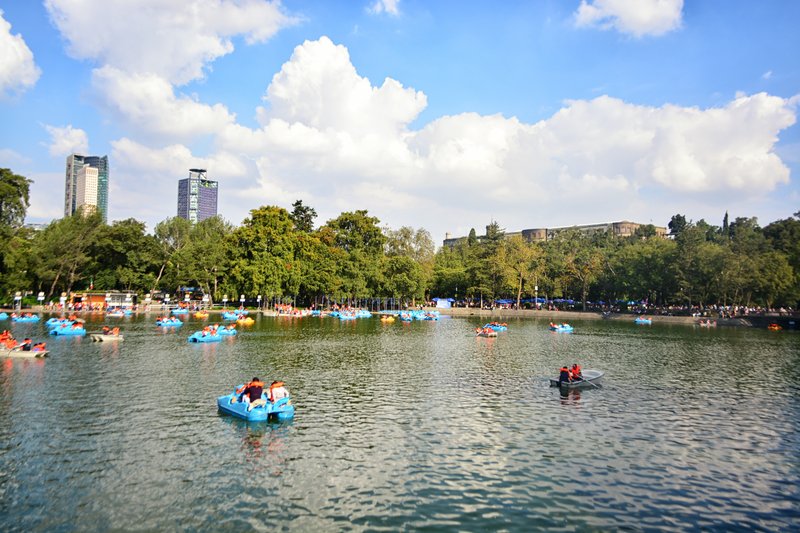
One of the largest city parks in the Western Hemisphere — more than twice the size of New York's Central Park — and a sacred site since Aztec times, when Moctezuma kept a private botanical garden here. The first section holds Lago Mayor, where rowboats cross a lake ringed by ahuehuete cypress trees that predate the Spanish conquest, plus the hilltop castle and the anthropology museum below.
Tuesday - Sunday 5:00am - 6:00pm
Closed Monday
Free
Lago Mayor, Bosque de Chapultepec, Mexico City
4.Museo Soumaya~1 hr
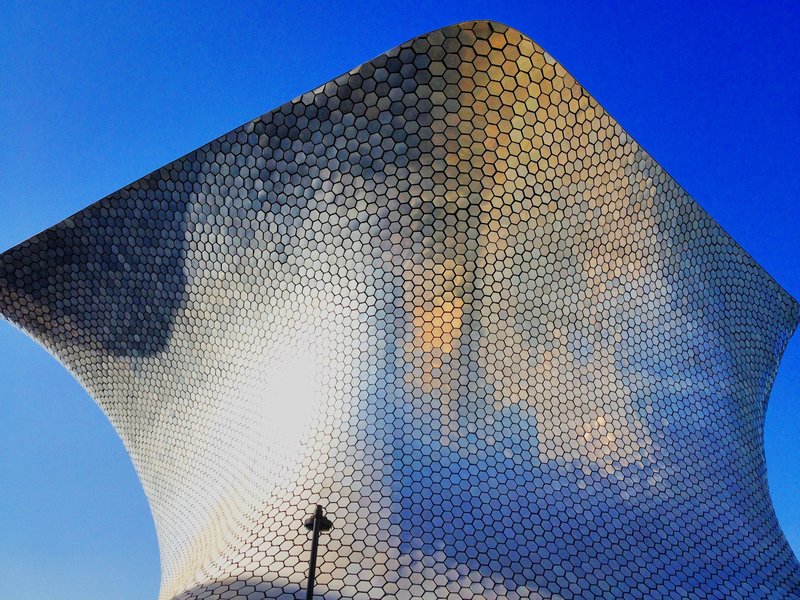
A private collection of more than 66,000 works spanning 30 centuries, free to enter, inside a wall-less silver structure wrapped in 16,000 hexagonal aluminum tiles — architect Fernando Romero's landmark in the Plaza Carso development. The holdings run from Mesoamerican and colonial art to the largest Rodin collection outside France, all arranged along a continuous interior ramp.
Museo Soumaya, Plaza Carso, Mexico City
Day 4
From Hotel: 24 min → Museo Frida Kahlo
1.Museo Frida Kahlo~1 hr 30 min
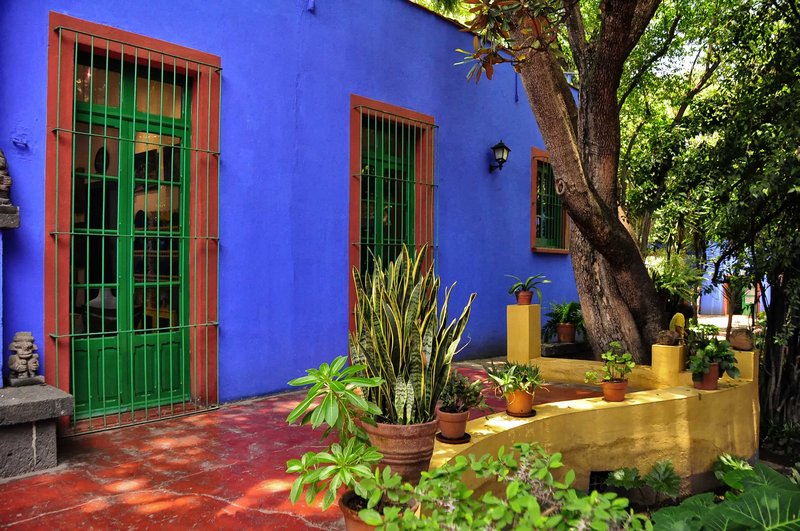
The cobalt-blue house where Frida Kahlo was born, lived with Diego Rivera, and died in 1954 — now the most-visited museum dedicated to a single artist in the Americas. Her studio, wheelchair and back braces, and Rivera and Kahlo's joint collection of folk art and pre-Hispanic pieces sit exactly as they left them, arranged around a courtyard garden full of the plants and stone idols she painted.
Museo Frida Kahlo · 4.5 · tiqets.com
Tuesday 10:00am - 6:00pm · Thursday - Sunday 10:00am - 6:00pm · Wednesday 11:00am - 6:00pm
Closed Monday
Museo Frida Kahlo · Casa Azul, Coyoacán, Mexico City
Coyoacán's historic center has good dining options
2.Jardín Centenario & Plaza Hidalgo~1 hr
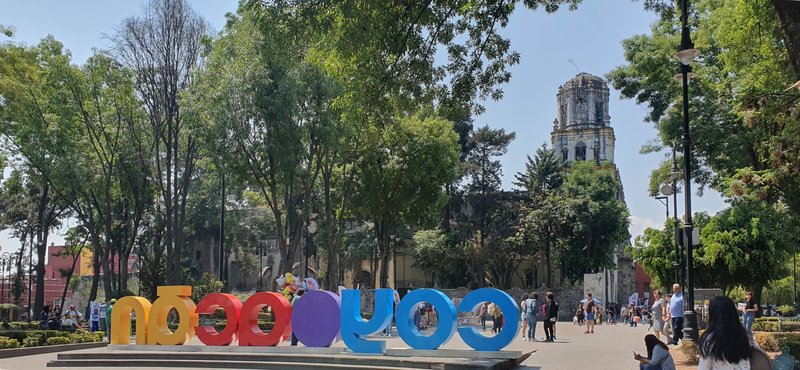
Coyoacán's twin 16th-century plazas, shaded by laurel trees and anchored by the coyote fountain that gives the neighborhood its name — Nahuatl for "place of coyotes." Musicians, portrait artists and churro stands surround the Parroquia de San Juan Bautista, one of the oldest churches on the mainland Americas, once Hernán Cortés's own base after Tenochtitlan fell.
Plaza Hidalgo, Coyoacán, Mexico City
3.Museo Anahuacalli~1 hr
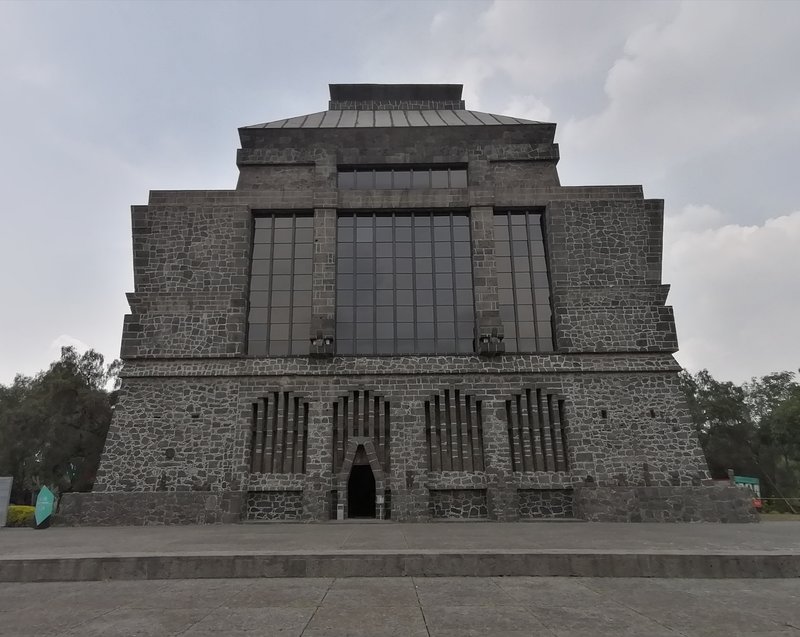
Diego Rivera designed this dark volcanic-stone "temple" himself to house his own 45,000-piece collection of pre-Hispanic art and to serve as his and Frida Kahlo's future mausoleum — a plan later abandoned. Mosaic ceilings assembled from broken pottery and obsidian, and galleries laid out like a Mesoamerican pyramid, make it one of the most unusual purpose-built museums in the country.
Museo Anahuacalli · 4.7 · tiqets.com
Tuesday - Sunday 11:00am - 5:30pm
Closed Monday
Museo Anahuacalli, Mexico City
4.Xochimilco~2 hr
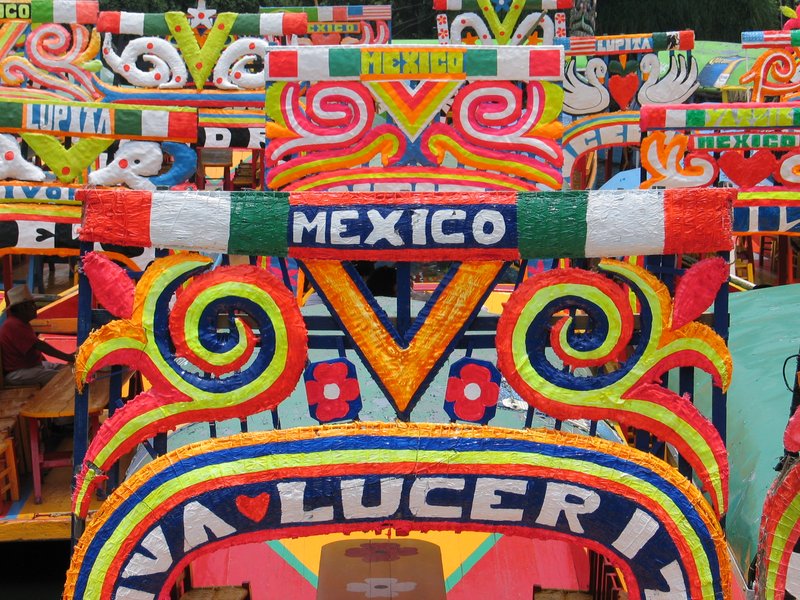
A UNESCO World Heritage network of canals and chinampas — artificial farming islands the Aztecs built from lake-bed reeds and mud, still cultivated today — the last fragment of the water world Tenochtitlan once floated on. Painted trajineras, poled by boatmen, drift past floating mariachi bands, marigold nurseries and food boats selling elote and micheladas.
Trajinera boats, Xochimilco, Mexico City
Day 5
From Hotel: 55 min → Zona Arqueológica de Teotihuacán
1.Zona Arqueológica de Teotihuacán~3 hr
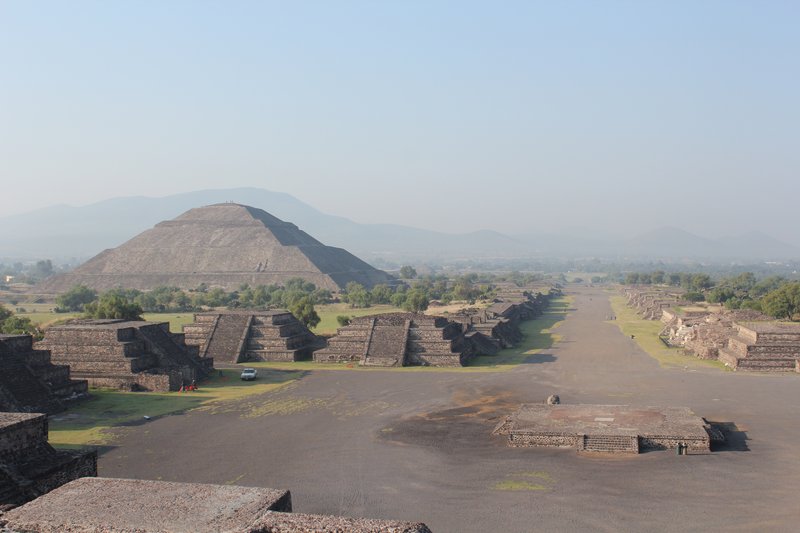
The largest ancient city built in the pre-Columbian Americas, among the biggest in the world at its 5th-century peak — its builders' name is lost; the Aztecs found it abandoned centuries later and named it "the place where the gods were created." The Pyramid of the Sun and Pyramid of the Moon flank the 2.4km Avenue of the Dead, with the Temple of Quetzalcóatl a short walk south.
Pyramid of the Sun and Avenue of the Dead, Teotihuacán
2.Basílica de Guadalupe~1 hr
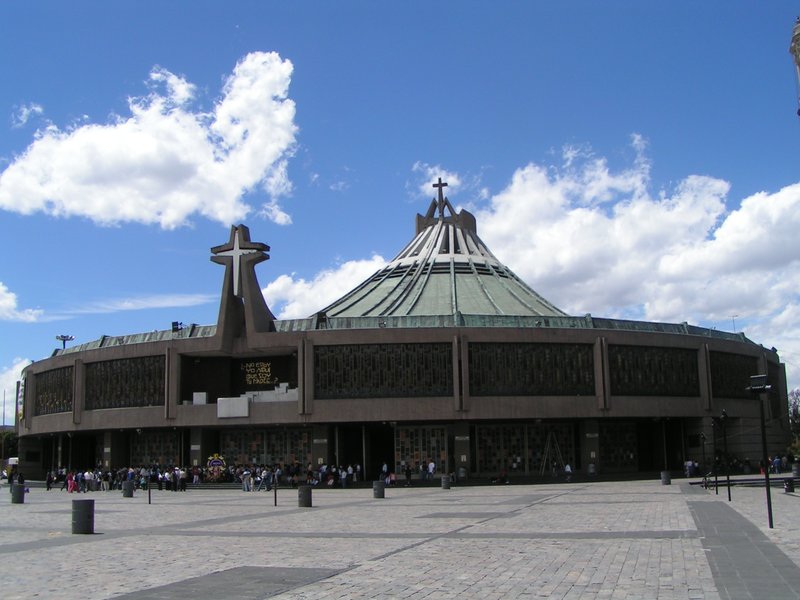
The most-visited Catholic shrine on earth after St. Peter's — over 10 million pilgrims a year come to see the cloak said to bear the Virgin of Guadalupe's 1531 image, mounted above a moving walkway inside a soaring 1976 rotunda seating 10,000. The 18th-century Antigua Basílica next door, sinking unevenly like the Metropolitan Cathedral, completes the complex.
Basílica de Guadalupe, Mexico City
3.Plaza de las Tres Culturas~45 min
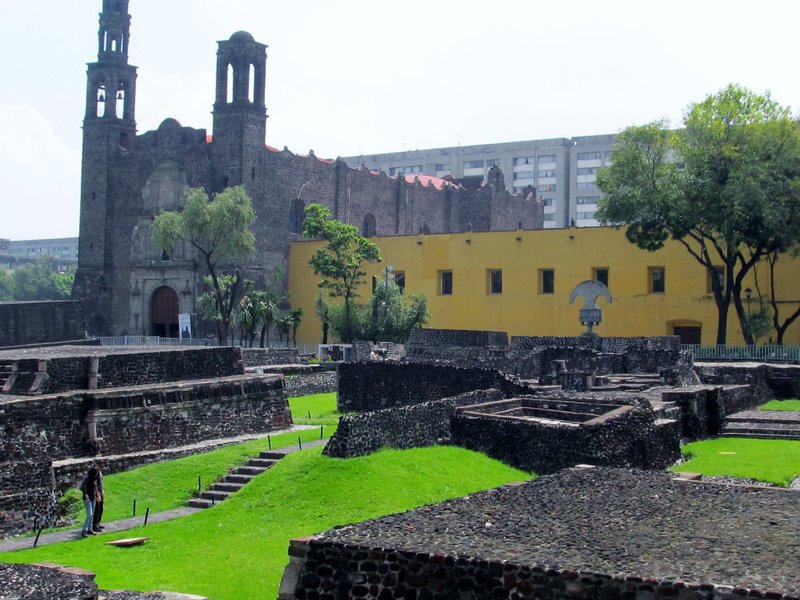
A single square stacking three eras of Mexican history: the excavated pyramids of Tlatelolco, the Aztecs' twin capital to Tenochtitlan and site of its 1521 defeat; the 16th-century Templo de Santiago built from the temple's own stones; and the 1960s towers where, in 1968, the army killed hundreds of student protesters days before the Olympics.
Plaza de las Tres Culturas, Tlatelolco, Mexico City
Weekly Closures
Museums · Closed Monday
Tours
Viator
A small-group walk through the pre-Hispanic and colonial layers of the historic center, framing Mexico City as a fusion of two civilizations told through its architecture.
3 hr · Max 12
30 min · 8 min → hotel
An evening at Arena México led by lucha libre devotees — a pulquería stop for pulque and live music before the masked wrestlers take the ring. Adults only.
3 hr · Max 50
38 min · 10 min → hotel
Full-day trip to the colonial city of Puebla, the Great Pyramid of Cholula, and the gilded Baroque interior of Santa María Tonantzintla, with a guide and driver.
11 hr · Small group
↔
Full-day small-group tour pairing the floating gardens and canal boats of Xochimilco with Coyoacán's colonial plazas, plus an optional stop at the Frida Kahlo Museum.
9 hr · Small group
↔
Small-group visit to the Pyramids of the Sun and Moon with a guide, round-trip transportation and a meal included.
6 hr · Small group
↔
GetYourGuide
Skip-the-line guided visit to Juan O'Gorman's functionalist studio-house in San Ángel, where Diego Rivera and Frida Kahlo lived and worked, separate from the Casa Azul museum.
2 hr · Small group
↔
A local guide walks the Zócalo, the Templo Mayor and the Palacio de Bellas Artes, tracing the city's Aztec-to-colonial-to-modern layers.
3 hr · Small group
22 min · 8 min → hotel
Half-day overview of Mexico City's landmark architecture and monuments, in Spanish or English.
4 hr · Small group
↔
Early-entry small-group visit to Teotihuacán ahead of the crowds and midday heat, with an archaeology-focused expert guide.
6 hr · Small group
↔
Combined day trip to the Teotihuacán pyramids and the Basílica de Guadalupe, pairing the region's ancient and its most-visited modern pilgrimage site.
8 hr · Small group
↔
TripAdvisor
A 12-traveler-max walk through the historic center's landmarks and hidden corners, built around local stories rather than a fixed script.
5 hr 30 min · Max 12
22 min · 8 min → hotel
Guided overview of the historic center covering the Palacio Postal, the National Palace's murals and the Palacio de Bellas Artes.
4 hr · Small group
↔
Early-morning small-group departure to Teotihuacán ahead of the tour-bus crowds, with an optional lunch stop on the return.
6 hr · Small group
↔
Full-day small-group trip to Teotihuacán with a guide covering the site's history, layout and major structures.
7 hr · Small group
↔
Small-group tour to Teotihuacán with site entrance included and a guide walking the Avenue of the Dead end to end.
6 hr · Small group
↔
Cappuccino
Café Regina · 4.6 · 900+ reviews
Daily 8:00am - 9:00pm
22 min · 9 min → hotel
Café XOXO Regina · 4.5 · 200+ reviews
Daily 8:00am - 8:00pm
22 min · 9 min → hotel
Cielito Querido Café · 4.4 · 500+ reviews
Daily 7:00am - 9:00pm
25 min · 10 min → hotel
Restaurants Near Hotel
El Cardenal · 4.6 · 500+ reviews
Century-old Mexico City institution in a restored Porfirian house — classic moles and escamoles.
Monday - Saturday 8:00am - 6:30pm · Sunday 8:30am - 6:30pm
20 min · 8 min → hotel
Los Girasoles · 4.3 · 300+ reviews
Colonial-home dining room facing the Zócalo — pre-Hispanic specialties like escamoles and chapulines alongside classic Mexican plates.
Monday - Saturday 9:00am - 9:00pm · Sunday 9:00am - 8:00pm
22 min · 8 min → hotel
Downtown Restaurants
Azul Histórico · 4.7 · 9500+ reviews
Open-air courtyard inside the Downtown Mexico Hotel, candlelit trees under a retractable roof — chef Ricardo Muñoz Zurita's regional Mexican recipes.
Daily 9:00am - 11:00pm
Café de Tacuba · 4.3 · 4500+ reviews
Mexico City's most famous historic restaurant, open since 1912 — ornate tiled dining rooms, live mariachi, and the house mole recipe that made it a landmark.
Daily 8:00am - 11:00pm
Dining Areas
Calle Regina · Centro Histórico
Hostería La Bota · Al Andar · Jekemir · Café Regina · Regina taco stands
Jardín Centenario · Coyoacán
Los Danzantes · Café Kowloon · Kahwen
Local Tastes
Tacos al Pastor
Spit-grilled marinated pork sliced straight onto a tortilla with a shaving of pineapple — invented in Mexico City by Lebanese immigrants adapting shawarma to local ingredients in the mid-20th century, now the city's defining street food.
Pulque
A viscous, mildly alcoholic drink fermented from the sap of the maguey — agave — plant, sacred to the Aztecs and served flavored, curado, with fruit, oats or nuts at traditional pulquerías found across the historic center and Xochimilco.
Mole
A family of complex sauces built from dozens of ingredients — chiles, spices, nuts, sometimes chocolate — simmered for hours; Mexico City's restaurants serve regional variants from Puebla, Oaxaca and beyond as a signature dish.
Food Delivery
Uber Eats
Foreign number: accepted. — the app sends the verification SMS to any international carrier, and Google or Facebook sign-in works as a fallback.
The broadest restaurant coverage in Mexico City and the easiest to use with an existing Uber account; card payment is straightforward for foreign cards, though surge-style delivery fees climb fast during rain or rush hour.
ubereats.com
Rappi
Foreign number: not accepted. — the sign-up flow expects a Mexican mobile number for verification, and payment with foreign cards is unreliable even after registering.
The largest selection in the city, including groceries and pharmacy items, not just restaurants — genuinely useful for a longer stay, but the sign-up friction makes it a poor choice for a short visit compared with Uber Eats.
rappi.com.mx
DiDi Food
Foreign number: accepted. — the code arrives by SMS on an international carrier via roaming, with Google sign-in also available.
Strong coverage in the historic center and Roma/Condesa, usually cheaper delivery fees than Uber Eats or Rappi, but with a smaller restaurant list outside those neighborhoods.
web.didiglobal.com/mx/food
Shows, Performances & Concerts
Ballet Folklórico de México · Palacio de Bellas Artes
Amalia Hernández's folkloric dance company performs regional dances in full costume beneath the theater's Art Deco Tiffany glass curtain.
tiqets.com
22 min · 8 min → hotel
Getting Around
Uber
Foreign number: accepted. — the code arrives by SMS on an international carrier, and the app works with the same account used at home.
The default choice for a short stay — widest coverage across the city, upfront pricing, and drivers used to picking up outside hotels and major sights; surge pricing during rush hour is the main downside.
uber.com
DiDi
Foreign number: accepted. — the SMS verification code arrives on an international carrier via roaming, or sign in with Google instead.
Usually a few pesos cheaper than Uber on the same route with similarly wide coverage, though the English-language interface is less polished and driver ETAs run slightly longer outside the city center.
didiglobal.com
Train Stations Near Hotel
Buenavista
Suburbano commuter rail to Cuautitlán and the northern suburbs, Mexico City's main hub for regional commuter service.
24 min · 8 min → hotel
Observatorio
Western terminus of the Tren Interurbano México-Toluca — "El Insurgente" — the only intercity passenger train serving Mexico City.
15 min → hotel
Day Trips by Train
Toluca · 50 min
Toluca de Lerdo, the State of Mexico's capital, ranks second only to CDMX for museums — the Museo de Bellas Artes, Centro Cultural Mexiquense and the stained-glass Cosmovitral Botanical Garden — plus colonial markets and the city's own chorizo.
book at: trenelinsurgente.mx or Omio
Michelin Restaurants
Pujol
Enrique Olvera's tasting menu built on Mexican corn and mole madre.
42 min · 16 min → hotel
Quintonil
Jorge Vallejo's vegetable-forward tasting menu from his rooftop garden.
44 min · 17 min → hotel
Rosetta
Elena Reygadas's Roma Norte kitchen pairs Italian technique with local produce.
38 min · 13 min → hotel
Heads Up
Museo Frida Kahlo — Tickets sell out
Casa Azul's timed tickets sell out online days to weeks in advance, especially weekends — reserve before you arrive.
Street Taxis — Skip the hail
Don't hail a taxi off the street. Call a hotel sitio cab or use Uber/DiDi instead — the standard safe choice here.
Altitude — Ease into day one
CDMX sits at 2,240m; a first afternoon of stairs and hills can leave you winded. Hydrate well and go easy on day one.
Worth Knowing

A city built on a lake that keeps reminding you

Mexico City sits at 2,240 meters — higher than Denver — on the drained bed of Lake Texcoco, and the ground has never stopped settling. Parts of the historic center have sunk more than 10 meters over the last century, unevenly enough that door frames and church floors visibly tilt; the altitude itself is the more immediate thing to plan around, since a first afternoon of stair-climbing and hill-walking can leave even fit travelers short of breath before they acclimatize.

The Metro carries about 4.5 million riders a day for roughly 5 pesos a ride, one of the best transit bargains anywhere, and its stations are worth a glance even without boarding — several sit atop excavated Aztec ruins uncovered during construction, with the artifacts displayed behind glass in the platform walls themselves.

Much of what a visitor sees is layered rather than replaced: the Spanish built their cathedral and government palace directly on top of Tenochtitlan's own sacred precinct and imperial palace, using the same stones, on the same site, so the city's Aztec and colonial history are not separate chapters but literally stacked on top of one another under the Zócalo.

Also on this site
Nearby Guides