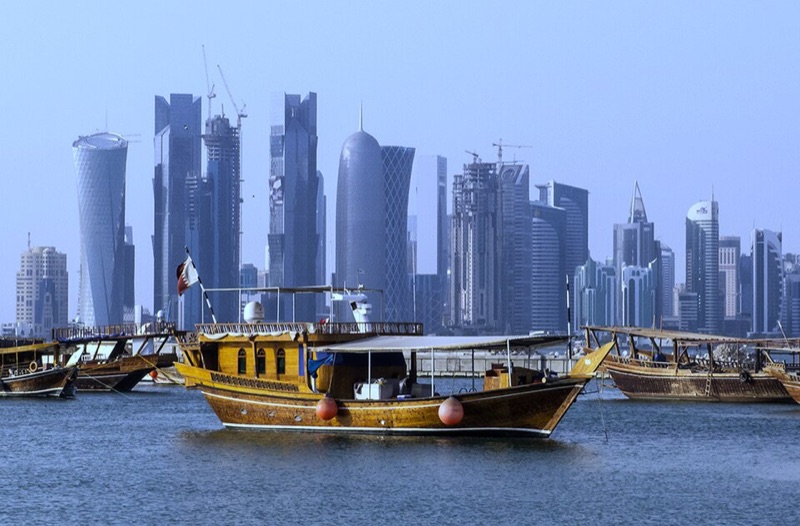
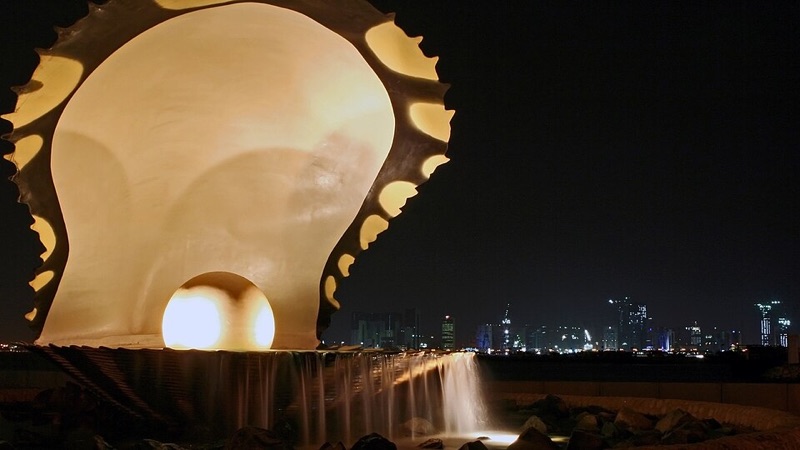
Seven kilometres of palm-lined waterfront tracing Doha Bay's arc, West Bay glass towers rising from the water on one side, dhow-scattered sea on the other. The promenade shifts from the MIA island at the south end through fishing piers to the skyline at the north — the most photographed cityscape in Qatar.
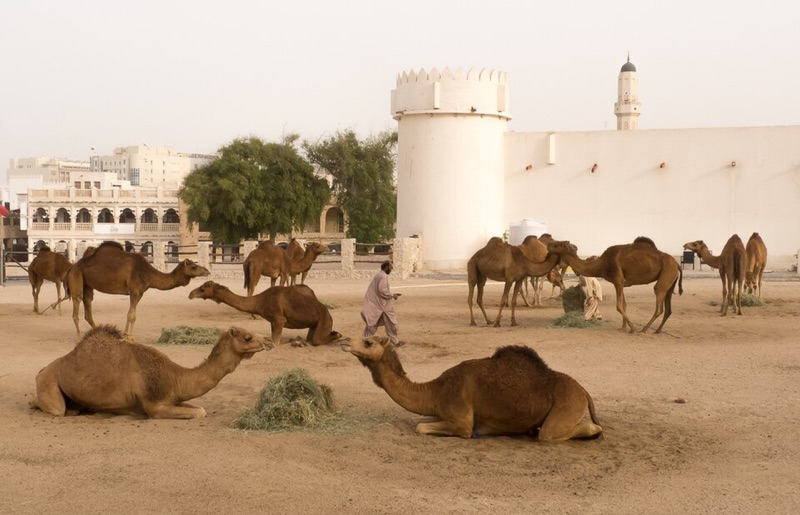
Built in the late 19th century by the Ottoman garrison, Al Koot — also called Doha Fort — is the city's oldest standing military structure. Its square plan and round corner towers sit at the edge of the old quarter, now housing a small museum charting Doha's transition from fishing village to capital.
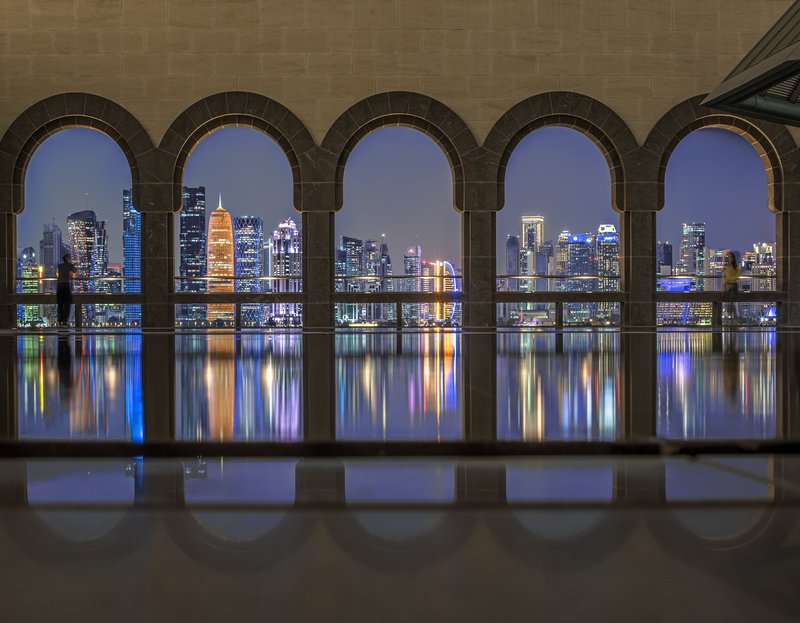
Built on its own artificial island in Doha Bay, I.M. Pei's stacked geometric volumes hold fourteen centuries of Islamic art — metalwork, ceramics, textiles, jewellery, and calligraphy from Spain to Central Asia. Octagonal cutouts flood the galleries with light; the West Bay skyline frames the scene from the water.
Qatar's largest artificial island, reclaimed from the sea off West Bay, is a residential and marina district evoking Mediterranean harbour towns. Porto Arabia's circular marina is lined with restaurants at water level; Qanat Quartier's Venetian-style canals add a second ring.
Qatar's cultural campus on the beach between West Bay and The Pearl: galleries, theatres, an amphitheatre, and restaurants along a seafront promenade. The Katara Mosque anchors it with an extraordinary Iznik-tiled blue facade. Families fill the alleys on Friday evenings with musicians near the fountain.
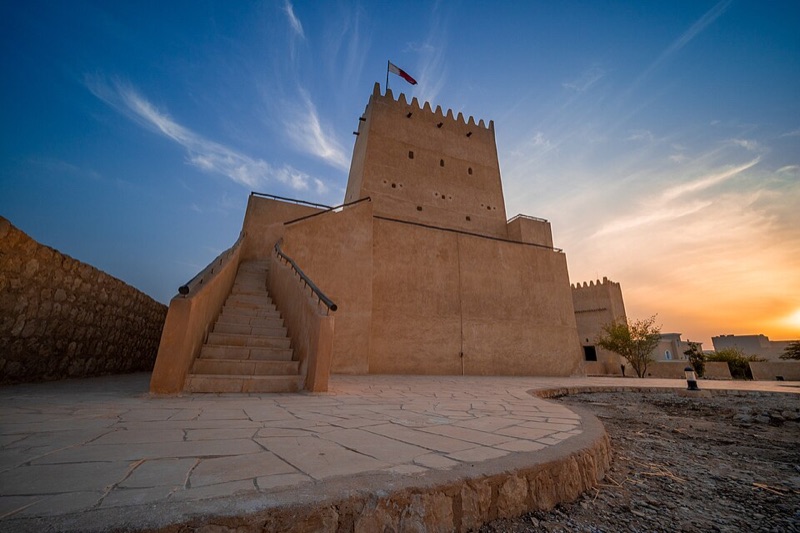
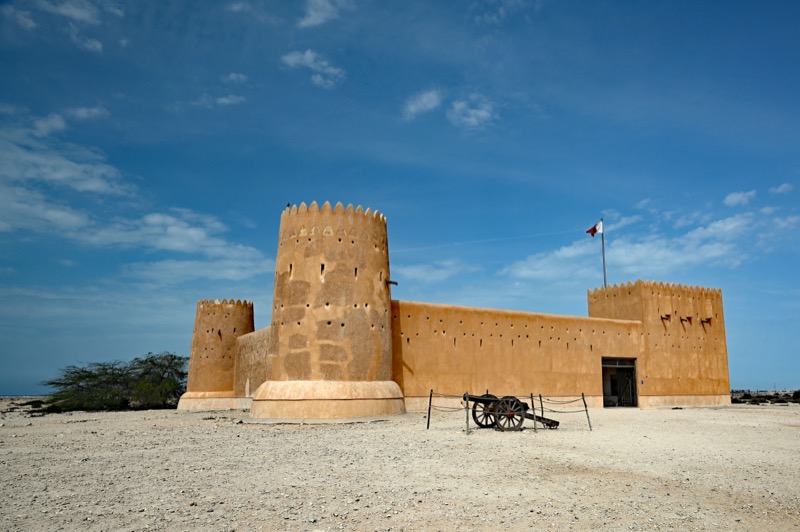
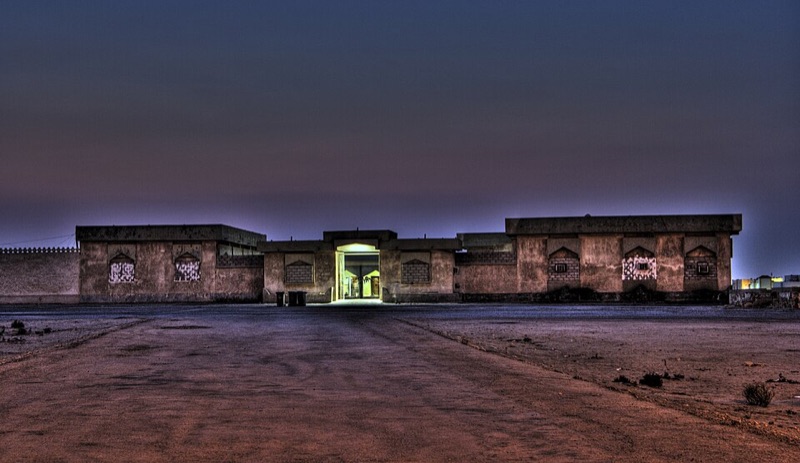
Two whitewashed watchtowers rising above the scrub plain of Umm Salal Mohammed, built for the Al Thani family to watch the desert and coastal approaches. The taller tower stands over a restored madrasa, mosque, and palm garden; the shorter sits near the road. Free to enter — Qatar's defensive past open to the sky.
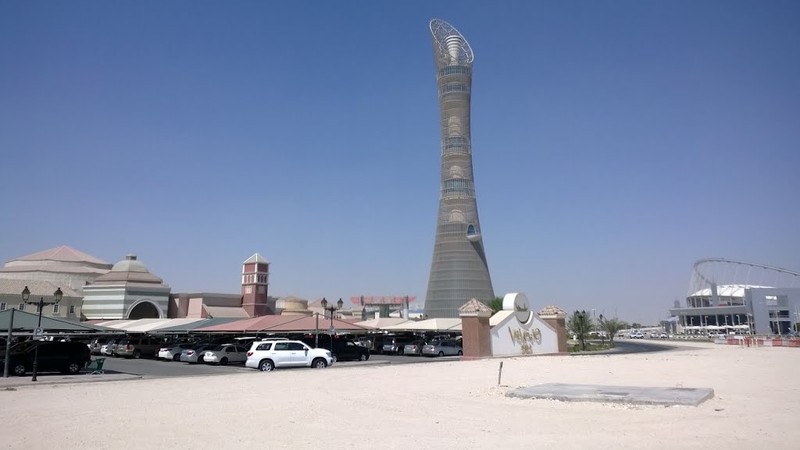
Qatar's 250-hectare sporting campus: Khalifa International Stadium, a FIFA World Cup venue, the Aspire Dome, world's largest indoor multi-sport hall, and the 300-metre Aspire Tower. The park and lake circuit is free and open — a walk around the grounds shows the full scale of what was built.
From Hotel: 1h 30min → Mathaf: Arab Museum of Modern Art
1.Mathaf: Arab Museum of Modern Art~2 hr
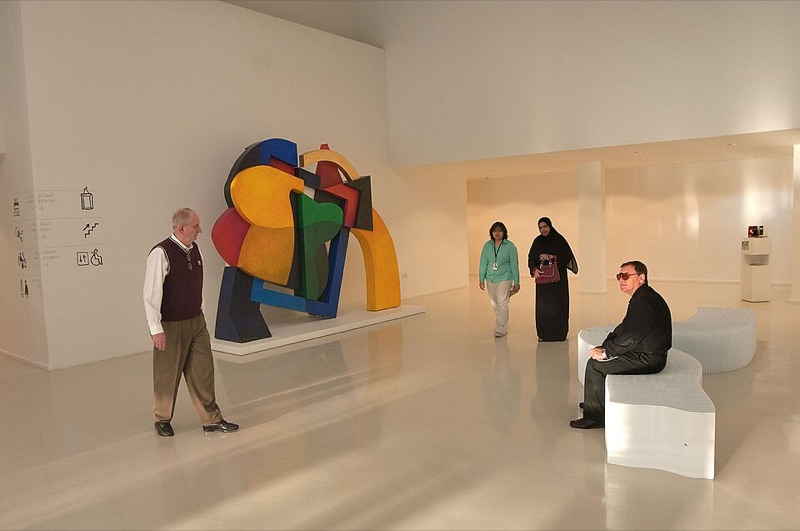
The Arab world's foremost museum of modern art, in a converted school on Education City campus, holds 9,000+ works tracing Arab artistic practice from the mid-19th century to today. The permanent collection is the strongest case anywhere for modern Arab painting — movements rarely seen outside the region.
Qatar's only UNESCO World Heritage Site: an 18th-century pearl-trading town whose 60+ hectares of coral-stone ruins survive under the desert. The fort houses the interpretive centre and a lookout platform. The 100 km drive north through flat scrub-desert is as much the draw as the site itself.
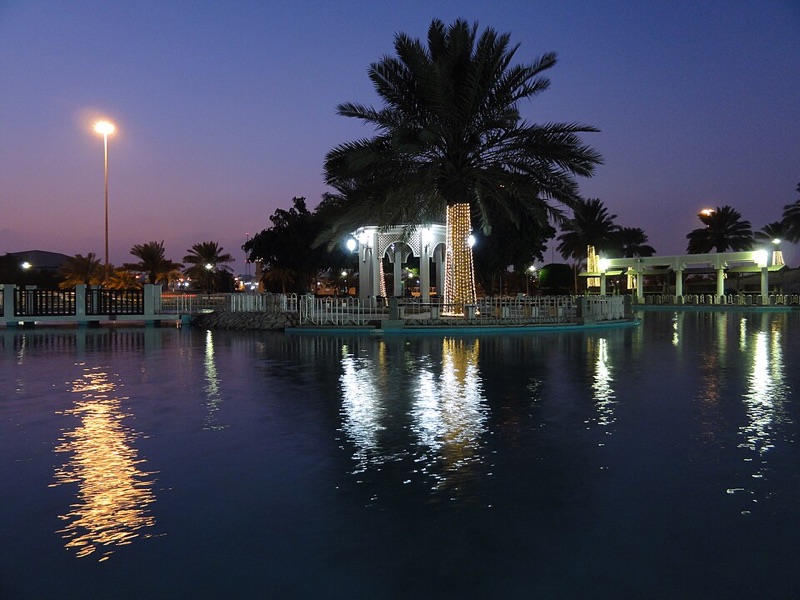
Doha's largest city park spans 40 hectares along the Corniche: a central lake, shaded walking trails, and an amphitheatre. The park's sightlines look out to the bay and back to the skyline — a rare green lung between the waterfront and the urban grid.
Jean Nouvel's interlocking disc structure, evoking Qatar's desert rose crystal, wraps around the old palace of Sheikh Abdullah Al Thani. Inside, galleries trace Qatar from ancient seabed through pearl-diving and the oil era. Among the most architecturally ambitious museum buildings in the world.
Rem Koolhaas designed this diamond-shaped building with the Heritage Library — Qatar's rare books and manuscripts — suspended at the centre of the main reading hall. Over 200,000 volumes across three floors; the bowl-shaped space funnels light down into the stacks — one of the Gulf's finest public buildings.
15 min · 5 min → Sheikh Faisal Bin Qassim Al Thani Museum
2.Sheikh Faisal Bin Qassim Al Thani Museum~2 hr
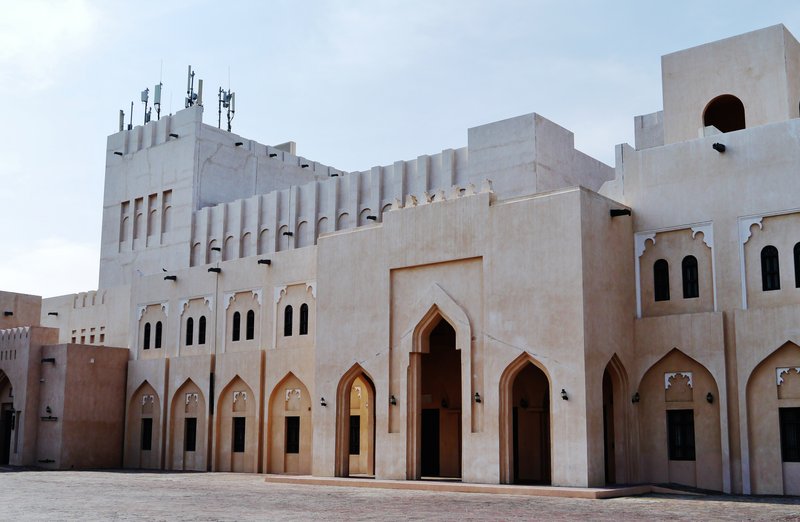
Qatar's largest private collection fills four halls in Al Shahaniya: Islamic manuscripts, antique Rolls-Royces and American cars, Qatari pearl-diving era artefacts, and coins from across the Islamic world. Assembled by a single collector over decades — one of the most eclectic collections in the Gulf.
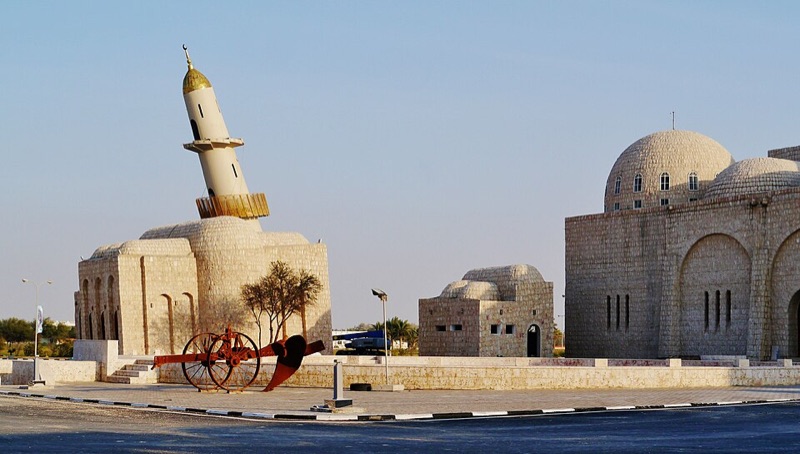
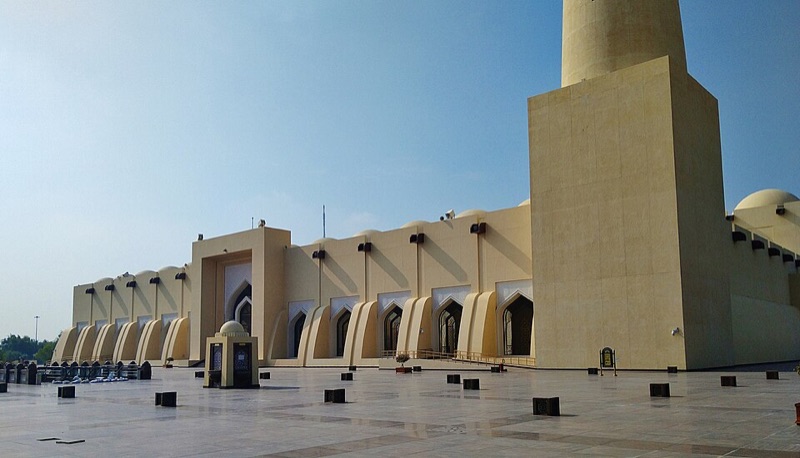
Qatar Foundation's campus mosque, designed by Ibrahim Al Jaidah with a distinctive drum-and-dome form: a circular ribbed drum supporting a white dome visible across the Education City campus. The interior holds 1,800 worshippers under a geometric arabesque ceiling. Open to non-Muslim visitors outside prayer times.
Al Wakrah is Qatar's best-preserved historic coastal town, 25 km south of Doha. The heritage village clusters around Wakra Fort and a restored fishermen's quarter of coral-stone houses, wind towers, and a mosque. The seafront promenade and beach give this city a human scale absent from Doha.
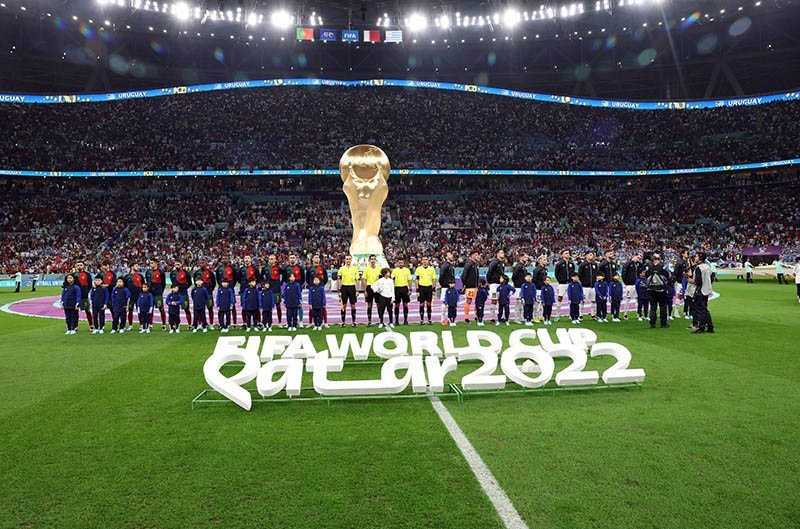
The 80,000-seat Lusail Stadium hosted the FIFA World Cup final — Argentina vs. France. The facade is modelled on a fanar lamp from Islamic tradition, its perforated geometric surface casting light-patterns across the exterior. The approach from Lusail's promenade reveals the full scale of the structure.
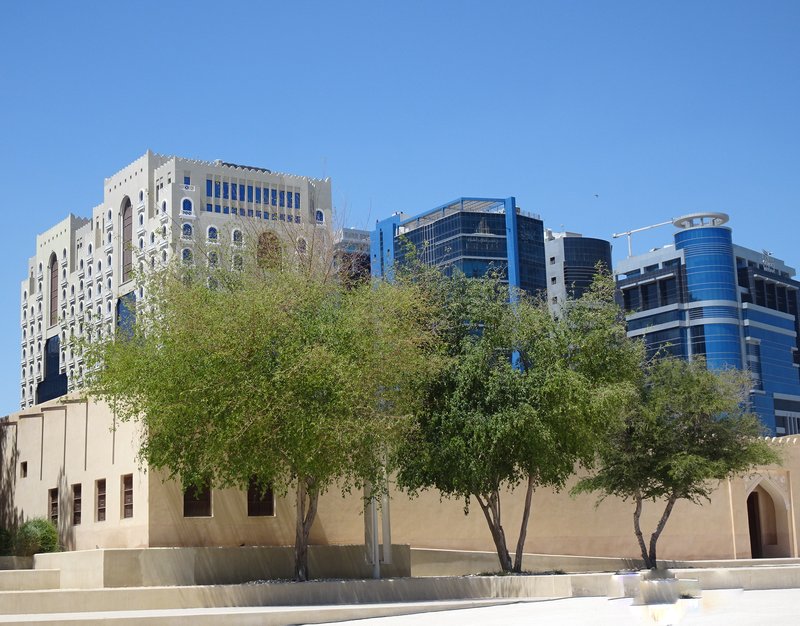
On-foot exploration of Souq Waqif's spice and falcon markets, continuing into the Msheireb Downtown district. Knowledgeable local guide covering cultural context, Qatari traditions, and architecture.
4WD dune bashing across the golden dunes south of the city, camel riding, sandboarding, and a stop at Khor Al Adaid — the Inland Sea where the desert meets the Arabian Gulf.
Qatar's national dish: basmati rice slow-cooked with lamb or chicken, dried lime, cinnamon, cardamom, and coriander. Rice absorbs the meat juices as everything braises — deeper and more fragrant than biryani.
Strong black tea simmered with cardamom, saffron, sugar, and evaporated milk — an Indian influence absorbed so deeply into Gulf daily life it's now as Qatari as anything. Served in small cups, very sweet.
Small, deep-fried dough balls — crispy outside, soft inside — drizzled with date syrup and sesame seeds. Eaten as a street snack or café dessert, common during Ramadan. Found at sweet shops throughout the city.
Foreign number: not accepted. — a Qatari number is required to receive the verification code.
The dominant delivery platform in Doha with the widest restaurant roster on the market; covers the West Bay hotels, the Pearl, and the central districts; strong selection of local Qatari restaurants and international chains; the registration barrier makes it unusable without a local SIM.
Foreign number: accepted. — it registers on any foreign SIM or eSIM, and the code arrives by SMS.
The practical alternative for visitors with a foreign number; launched by Meituan and growing its Doha restaurant list steadily; covers West Bay, the Pearl, and the main hotel zones; selection is smaller than Talabat but spans enough international options for most stays.
Foreign number: accepted. — sign-up is SMS-only and app-store reviews report codes that never arrive; if yours does not, book at a hotel rank or through the 4458 8888 dispatch line.
Qatar's state taxi and ride-hailing service; metered, well-maintained vehicles and fixed fares to the main hotels; reliable across West Bay, Katara, and the Pearl; the official app books rides in advance and shows the fare before confirming.
Foreign number: accepted. — the verification code arrives by SMS on a foreign SIM, and the app can also verify through WhatsApp.
Operates across Doha with strong supply in West Bay and the Pearl; useful for rides between the Museum of Islamic Art, Katara, and the Souq Waqif area; fares are competitive with Karwa taxis and the app routes clearly in the city's newer districts.
Doha rewards the kind of visit that doesn't rush the surface. Day 1 puts you in front of two of the most architecturally extraordinary museum buildings anywhere — I.M. Pei's island floated in the bay, and Nouvel's interlocking discs that read differently every time the light changes.
Day 2 pulls back to show the physical scale of what Qatar has built in a generation: watchtowers from a desert past north of the city, a sporting campus that hosted a World Cup, and a cultural village that works as a place people actually want to be in the evening.
Day 3 is the inversion — 100 km of flat scrub-desert highway to reach a walled trading town that went silent two centuries ago, then back south to a free art museum that is seriously, quietly excellent.
Day 4 belongs to the Corniche and the waterfront: the promenade walk, the park that makes the city feel inhabitable, the Ottoman fort hiding behind the old quarter, and The Pearl's enormous reclaimed island at the end.
Day 5 crosses the desert to a private collector's four-hall museum — the car collection alone is worth the drive — then back through Education City for Koolhaas's library and Al Jaidah's drum-and-dome mosque, both serious buildings.
Day 6 covers the full north-south extent: Al Wakrah in the south is Qatar's most human-scaled town, an antidote to Doha's glass ambition; Lusail in the north is the stadium that hosted the most-watched football final in history.