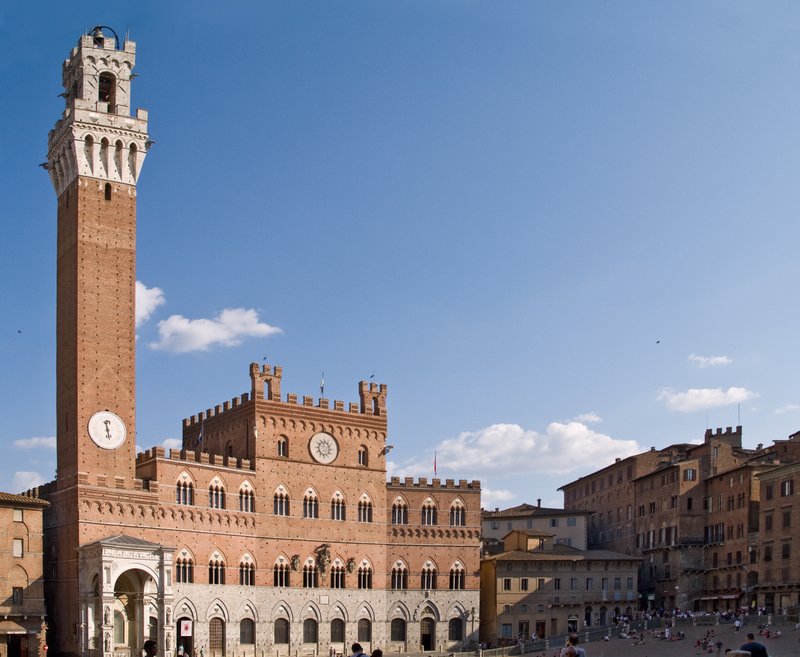
Siena's Gothic town hall on the Campo. Inside, the Museo Civico holds Ambrogio Lorenzetti's Allegory of Good and Bad Government — one of the most important secular fresco cycles of the Middle Ages — and the 102-metre Torre del Mangia climbs roughly 400 steps to the finest view in the city.
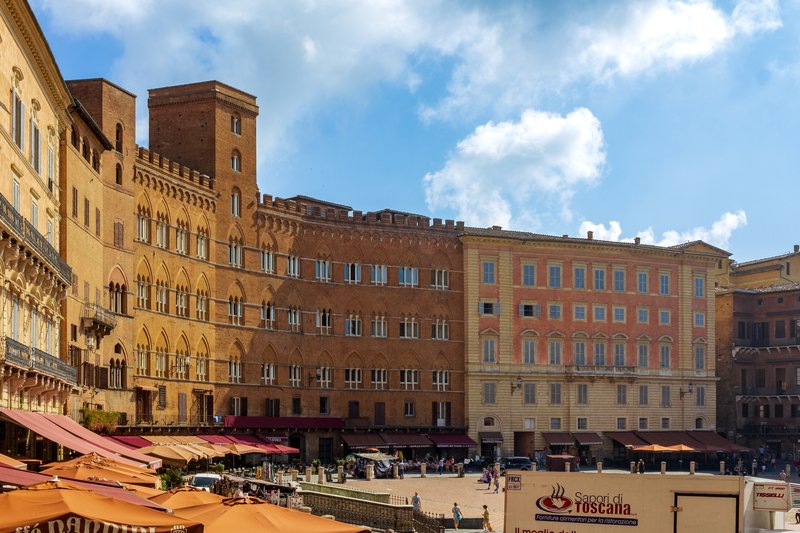
Siena's shell-shaped medieval square, sloping toward the Palazzo Pubblico in nine paved segments — the social heart of the city and the stage for the twice-yearly Palio horse race. Ringed by Gothic palaces, it is one of Europe's greatest public spaces.
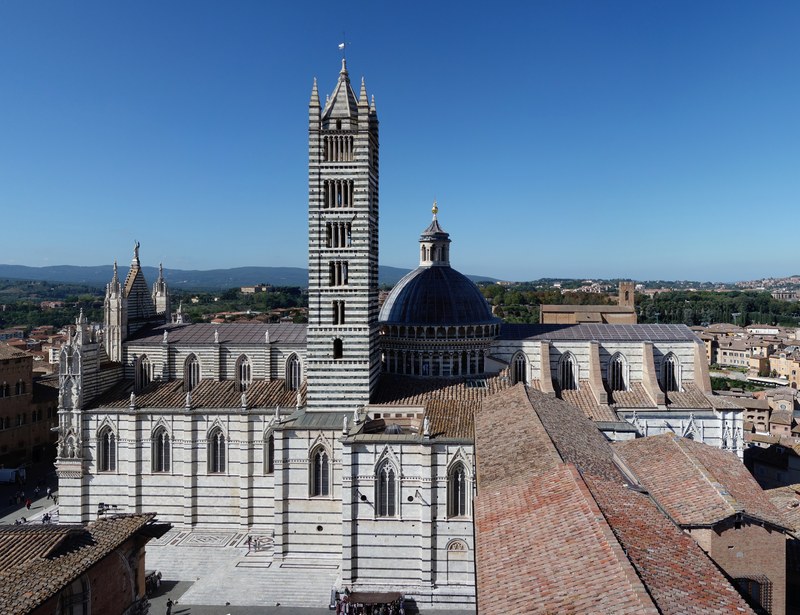
One of Italy's grandest Gothic cathedrals — banded black-and-white marble inside and out, a mosaic-inlaid floor of 56 panels worked by Sienese masters over two centuries, Nicola Pisano's carved pulpit, and the fresco-lined Piccolomini Library.
A vast former pilgrim hospital facing the cathedral, one of Europe's oldest, now a sprawling museum complex over four sloping levels. The Pellegrinaio hall blazes with 15th-century frescoes depicting the hospital's care of the sick and its charity — a rare secular cycle of everyday medieval life.
1 min · 1 min → Palazzo Chigi Piccolomini alla Postierla
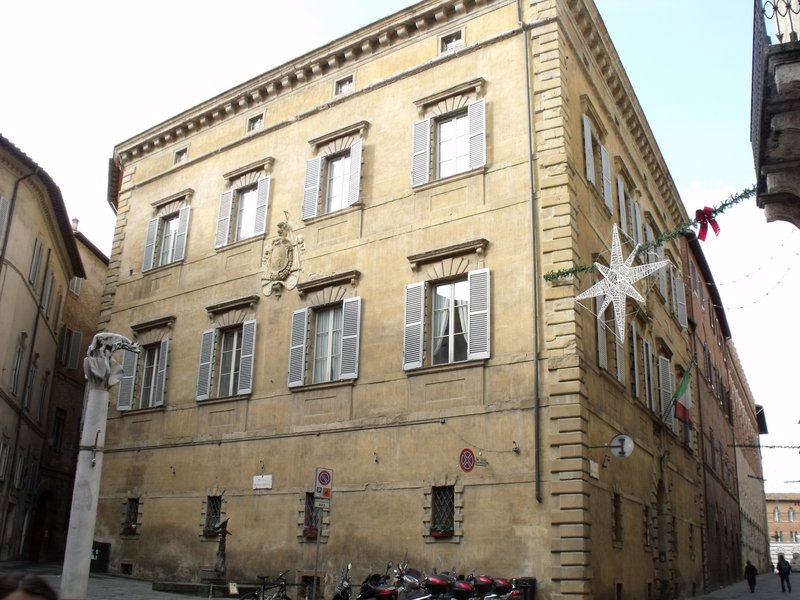
3.Palazzo Chigi Piccolomini alla Postierla~30 min
The Pinacoteca Nazionale's satellite gallery, keeping part of the collection on view during the main museum's renovation. Frescoed 1573 halls hold 17th-century Sienese paintings by Rutilio Manetti, Bernardino Mei and Raffaello Vanni — the Pinacoteca's own gold-ground Duccio, Martini and Lorenzetti masterpieces stay closed with the main building.
Kept open with extended hours specifically while the Pinacoteca Nazionale is closed — hours may revert once it reopens, check the official site before visiting.
A large Gothic Franciscan basilica begun in the 14th century on the city's eastern edge. The interior preserves fragments of Pietro and Ambrogio Lorenzetti's fresco cycles; the adjacent Oratorio di San Bernardino connects the complex to Siena's most important preacher.
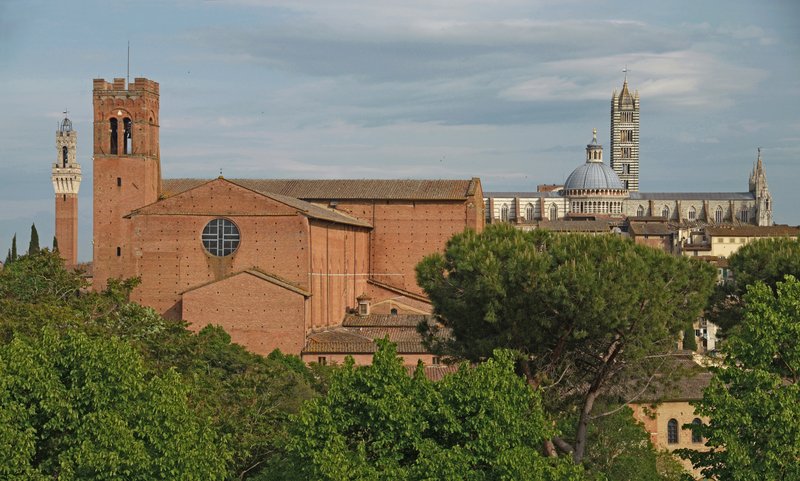
The great Dominican fortress-church above the Fontebranda valley, built from 1226 in spare Gothic brick. The Cappella di Santa Caterina preserves the head of St. Catherine of Siena in a reliquary, flanked by Sodoma's 1526 frescoes of her ecstasies and stigmata.
A massive brick fortress commissioned by Cosimo I de' Medici in 1560 to dominate the conquered city. The rampart walk gives the widest panorama in Siena; inside, the Enoteca Italiana hosts Italy's national wine library — hundreds of bottles available by the glass.
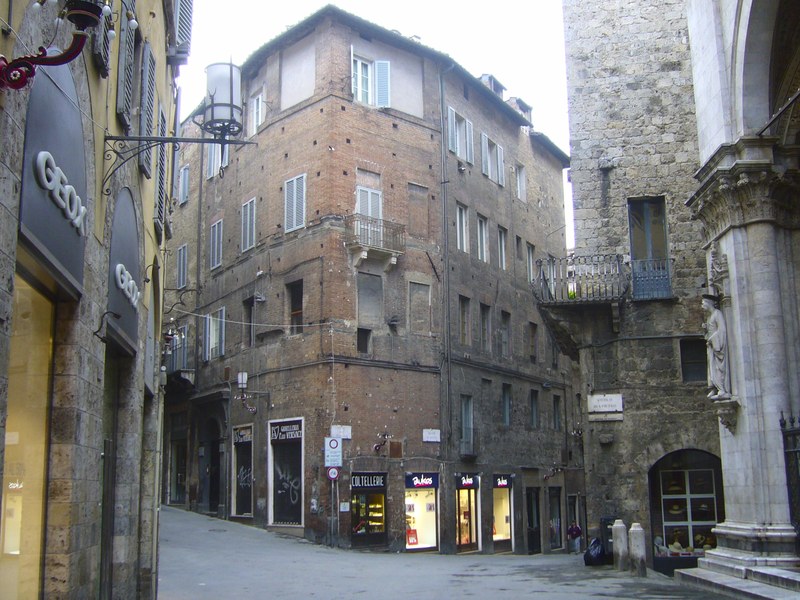
The medieval column at the exact point where Siena's three districts — Terzo di Città, Terzo di San Martino, and Terzo di Camollia — converge at the foot of Via di Città. Three tabernacles hold images of the patron saints of each district; surrounding streets are lined with the finest Gothic palaces in the city.
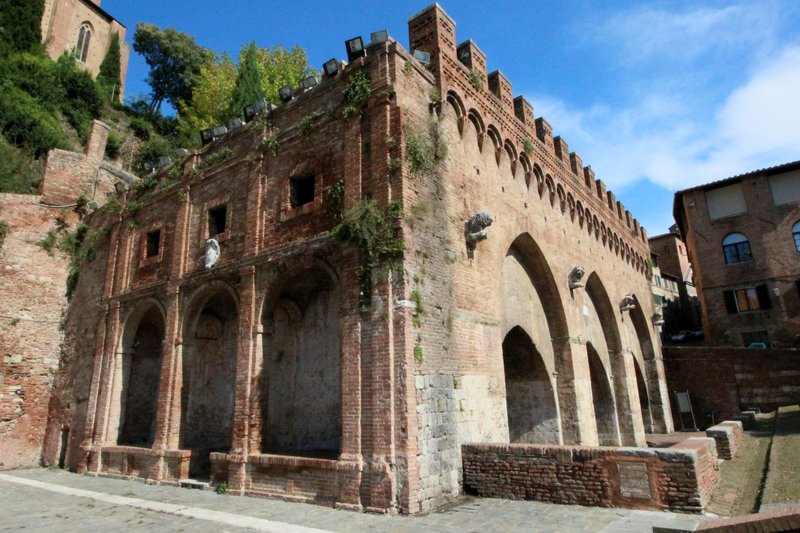
Siena's oldest and largest public fountain, documented in 1081 and rebuilt to its current Gothic form in 1246. Three wide arches with crenellated battlements shelter the original pools for drinking, animal watering, and laundering. Dante cited it in the Inferno; it sits below the San Domenico hill.
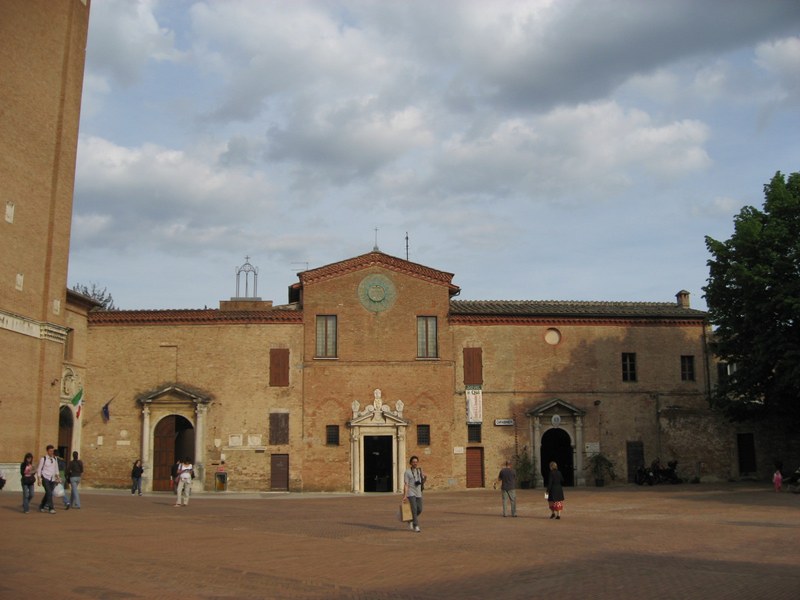
A two-storey Renaissance oratory next to the Basilica di San Francesco, built where St. Bernardino of Siena preached in the early 15th century. The upper chapel is painted floor-to-ceiling with scenes from the Virgin's life executed between 1496 and 1518 by Sodoma, Beccafumi, and Girolamo del Pacchia.
A Gothic Servite basilica on Siena's southern hill, begun in the 13th century. The interior holds Coppo di Marcovaldo's 1261 Byzantine Madonna, a Lorenzetti altarpiece, and a Lippo Memmi Madonna — with a wide terrace outside giving the finest view of the Campo and Torre del Mangia.
A full-day guided trip from Siena to three family-owned wineries in Montalcino — taste Brunello at each, enjoy a traditional Tuscan lunch at a winery, and explore the abbey of Sant'Antimo. Limited to 8 guests.
A 2-hour walk through the cobbled medieval core with an English-speaking guide, then inside the Cathedral to see masterpieces by Donatello, Michelangelo, and Pisano with skip-the-line tickets.
A full-day tour from Siena through the Chianti Classico wine region — a medieval castle winery for tastings, a hilltop lunch, and the UNESCO medieval towers of San Gimignano at golden hour. One of the most scenic full-day Tuscan excursions departing Siena.
A 10-hour guided day trip from Siena into the UNESCO Val d'Orcia — rolling hills, cypress avenues and medieval villages including Pienza and Montepulciano, with winery tastings of Brunello and Vino Nobile and a traditional Tuscan lunch included.
A full-day guided trip to Montalcino — stops at three wineries for Brunello tastings, a Tuscan winery lunch, and time in Montalcino town before visiting Sant'Antimo abbey. Max 8 guests. Meets at Piazza San Domenico.
A full-day small-group excursion from Siena to three Tuscan highlights — the tower-studded UNESCO town of San Gimignano, a Chianti Classico winery for tastings and lunch, and the hill town of Montalcino for a Brunello tasting in historic cellars.
Foreign number: not required. — it signs in with Google, Facebook or email, and a phone sign-up takes any prefix with the code by SMS or WhatsApp.
Active in Siena's city centre, covering local restaurants and some grocery partners; selection is smaller than in larger Italian cities given Siena's size. Delivers across the historic centre and surrounding districts.
Foreign number: not required. — the account is made with Google, Facebook or an email address — there is no phone field, so no code has to arrive.
Operates in Siena with restaurant delivery from local and chain venues across the historic centre; coverage is more limited than in larger Tuscan cities. Minimum order thresholds apply per restaurant.
Foreign number: accepted. — the code comes by SMS or WhatsApp, and WhatsApp reaches a foreign number over data; an email code then finishes the sign-up.
Italy's licensed-taxi booking app, connecting riders with Siena's local radio-taxi fleet; all vehicles are metered taxis operating at official municipal fare rates. Book in advance for early-morning or late-night trips — the local fleet is smaller than in major Italian cities.
A Chianti town on the direct Siena-Empoli regional line and the closest train stop to San Gimignano — the medieval towers visible on the hillside. The town holds the unfinished Fortezza Medicea and Benozzo Gozzoli frescoes in the municipal museum.
A quiet hill town set in the lunar clay badlands of the Crete Senesi — the Museum of Sacred Art with Duccio-school panels, and rolling ochre ridges that look nothing like the rest of Tuscany. Direct train on the scenic Trenitalia line via Siena FS.
A Valdarno market town with the Museo della Collegiata holding Masolino and Pontormo altarpieces. The direct Siena-Empoli regional train terminates here at a mainline junction for Florence and Pisa.
An Etruscan hilltop city perched above the Val di Chiana — the National Etruscan Museum with bucchero ware and bronze mirrors, a network of underground Etruscan tunnels, and a medieval labyrinth open for guided visits. Trenitalia regional trains serve Chiusi-Chianciano Terme on the Siena FS line.
The cradle of the Renaissance — the Uffizi, the Duomo, the Accademia's David, and Ponte Vecchio. A direct Trenitalia regional train links Siena to Florence with no change.
Siena is a city you read with your feet. The Campo isn't flat — it tilts, nine brick segments fanning down to the Palazzo Pubblico like the inside of a scallop shell, and that slope is deliberate: medieval Siena built its civic heart as a basin so the whole population could gather facing its government. Stand at the low point and the Torre del Mangia rises exactly as the architects intended you to feel it — small below power.
The color has a name because of this place. "Burnt sienna" is the local earth, the raw ochre dug from these hills and roasted darker; the whole town is painted in versions of it, which is why the city seems to glow at the hour the light goes amber — the same warm stone that makes the cathedral's striped marble so startling, black and white and austere, against streets that are entirely terracotta.
And the rivalry never sleeps. The seventeen contrade — the Eagle, the Snail, the Wave, the Tower, the She-Wolf — are not folklore for tourists; they are the living social fabric, each with its own church, fountain, museum, and colors, and twice a year they send horses thundering around that shell-shaped square in the Palio. Walk the back lanes and you'll spot the boundary plaques and flags. You are never just in Siena. You are always in one of its seventeen smaller cities at once.