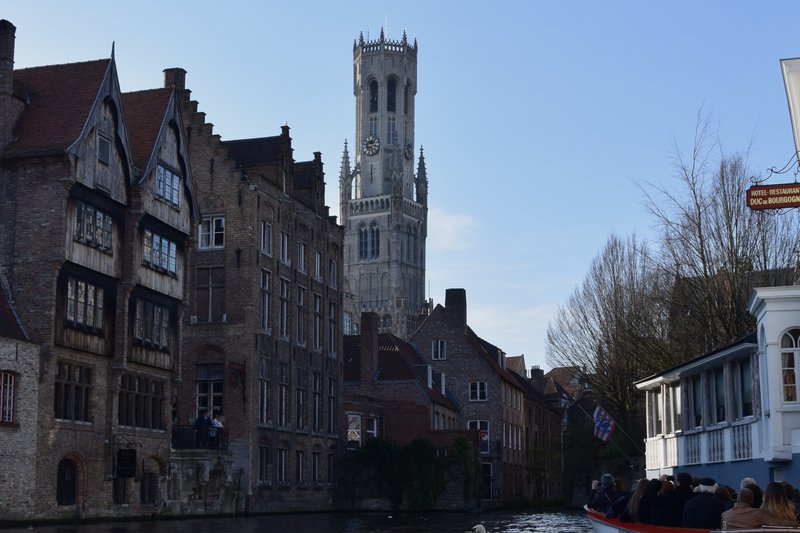
The most photographed spot in Bruges — a canal quay where the still water mirrors the Belfry and the stepped gables behind it. Pure postcard, and best of all at golden hour.
Bruges' second great square and its civic birthplace, framed by the Gothic City Hall and the Basilica of the Holy Blood. Quieter than the Markt, with a thousand years of architecture standing side by side.
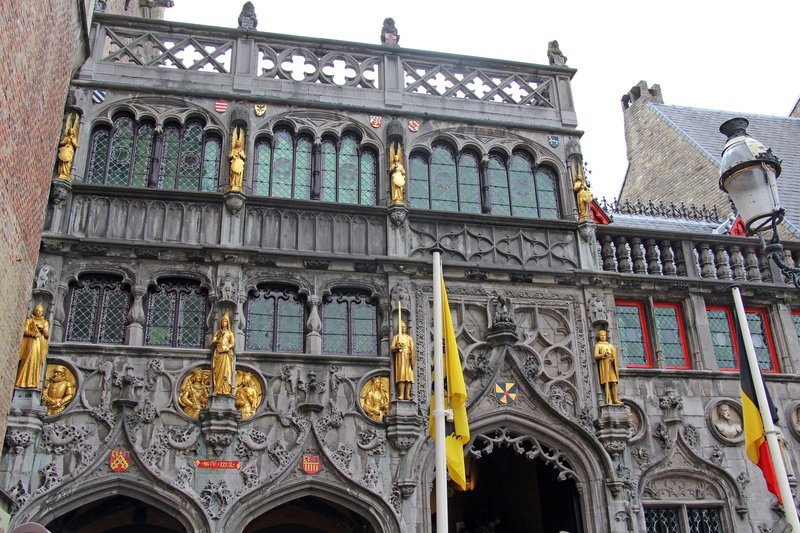
A twelfth-century basilica on the Burg housing a venerated relic said to hold drops of Christ's blood. A plain Romanesque lower chapel sits beneath a richly decorated Gothic upper chapel.
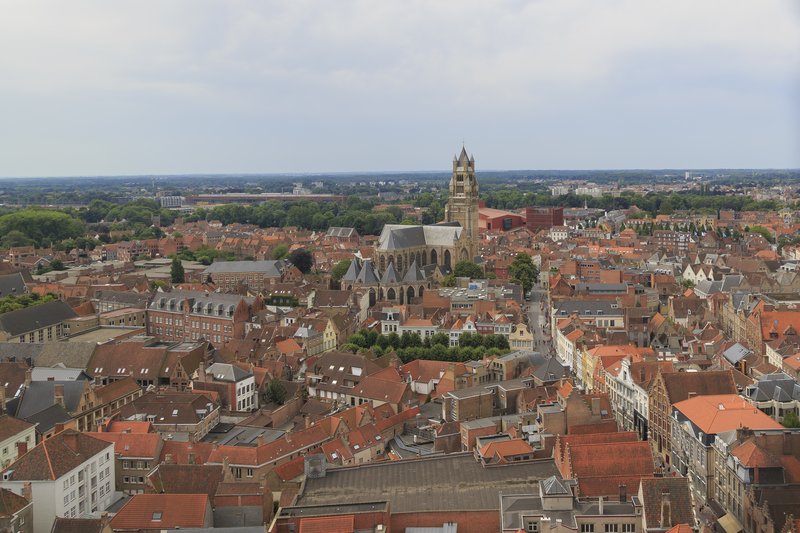
The 83-metre medieval bell tower over the Markt, climbed via 366 narrow steps to a panoramic view across the rooftops. Its 47-bell carillon still rings out over the city.
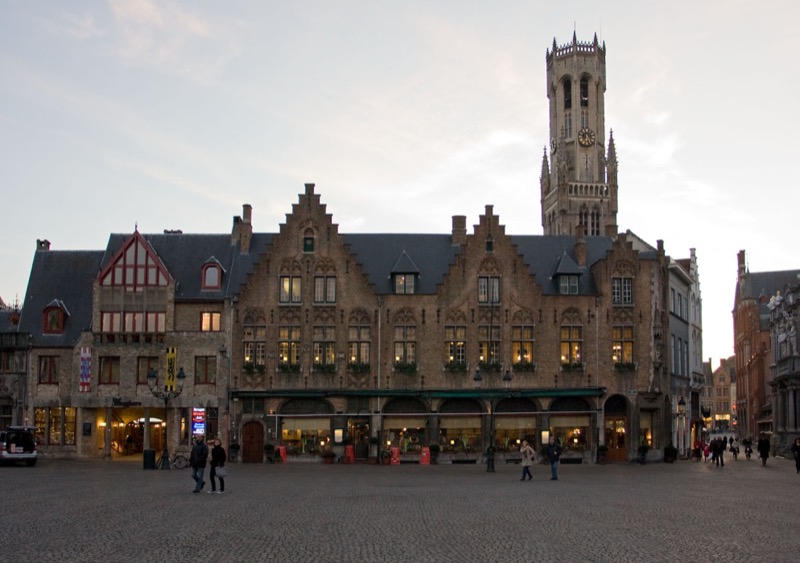
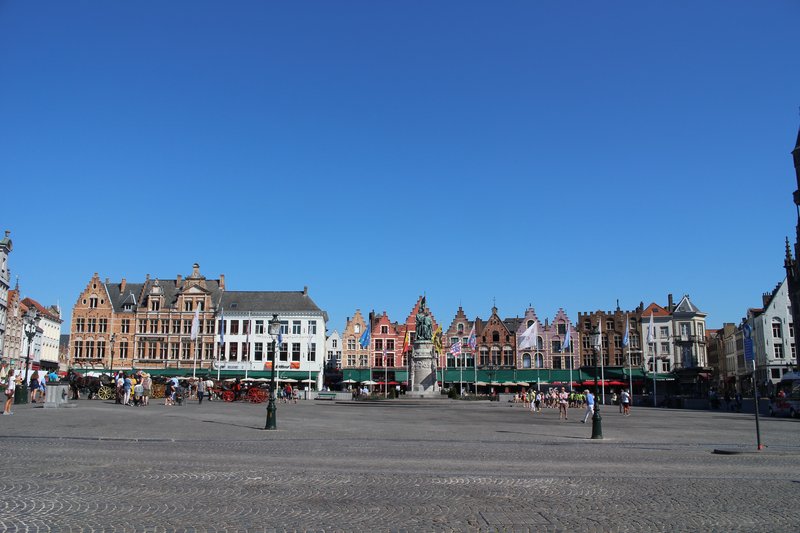
Bruges' grand market square, ringed by stepped-gabled guild houses and crowned by the towering Belfry. The medieval heart of the city and its liveliest gathering place, edged with café terraces and the neo-Gothic Provincial Court.
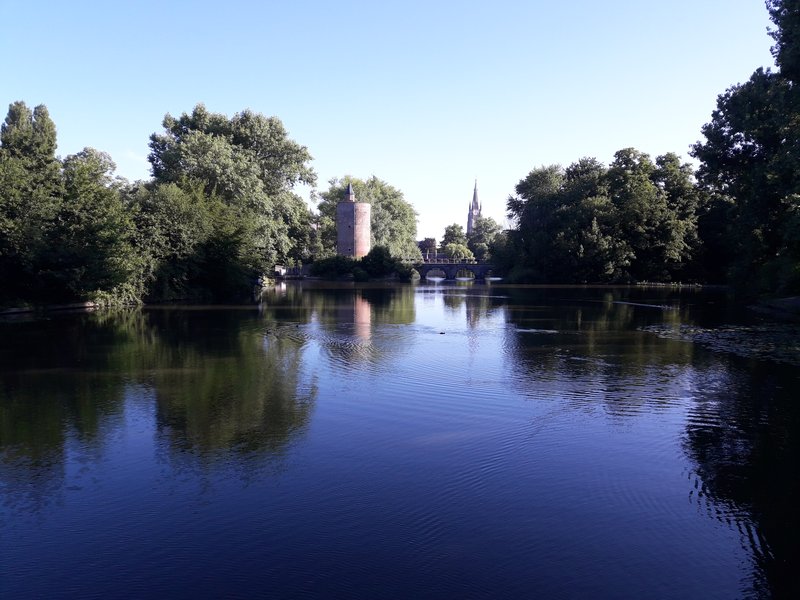
The "Lake of Love" — a willow-fringed canal basin and park at the southern edge of the old town, where swans glide beneath an old stone bridge. The quietest, most romantic corner of Bruges.
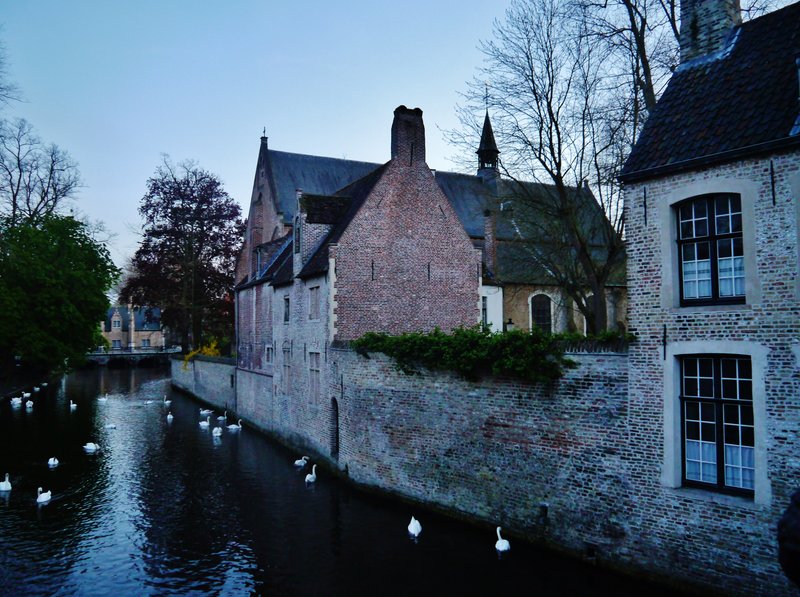
A serene, walled courtyard of whitewashed houses founded in 1245 for the Beguines — lay religious women who lived in community. A UNESCO World Heritage site, hushed and green even at the height of summer.
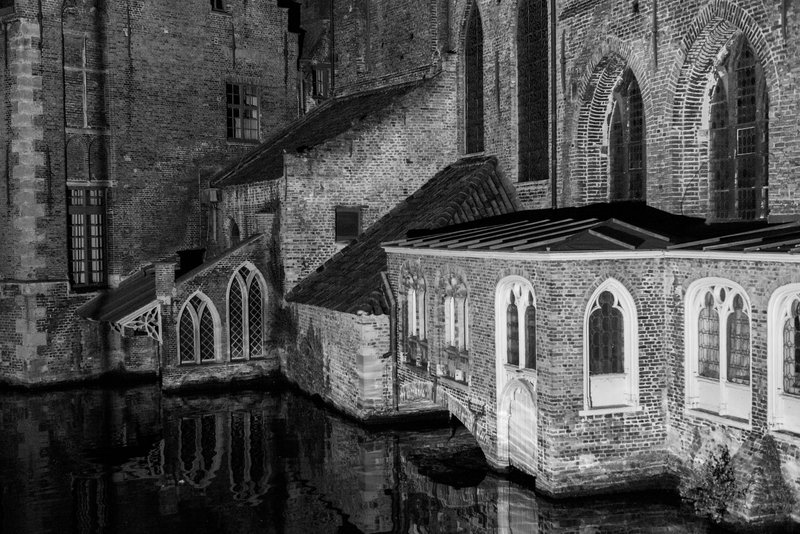
One of Europe's oldest surviving hospital buildings, founded in the twelfth century. The former sick wards now hold six masterworks by Hans Memling, painted here in the 1480s.
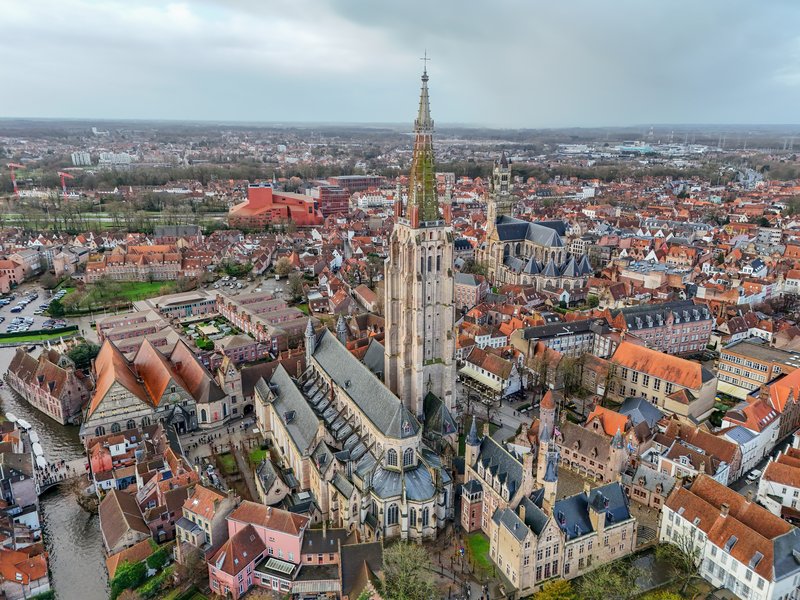
Home to Michelangelo's marble Madonna and Child — the only sculpture by the master to leave Italy in his lifetime. Its brick spire, at 115 metres, is among the tallest in the world.
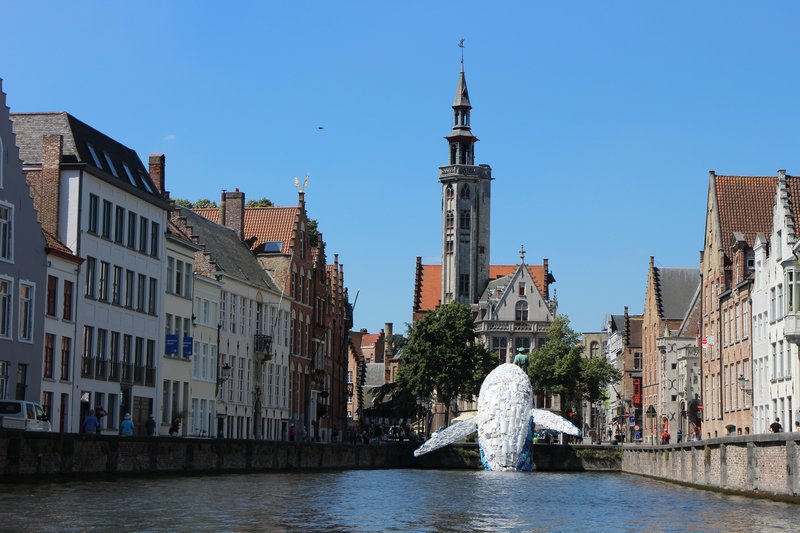
The commercial heart of medieval Bruges, named for Jan van Eyck who lived nearby from 1432 to 1441. A bronze statue of the Flemish master stands at the centre, ringed by 15th-century guild houses and the turreted Poortersloge — the Burghers' Lodge — along the canal.
A privately owned 15th-century chapel built by the Adornes family as a faithful copy of the Church of the Holy Sepulchre in Jerusalem — the only one of its kind in northern Europe. The tomb of Anselm Adornes lies at its centre, and the Adornes family still owns and maintains the building today, more than five centuries later.
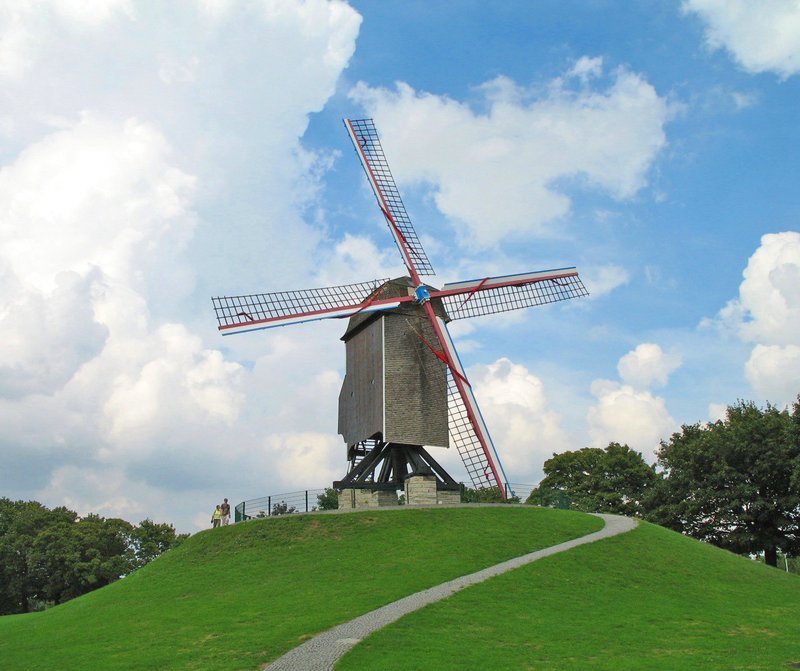
The last working windmill in Bruges, standing on the green rampart ridge above the old moat since 1770. Three other windmills line the Kruisvest beside it — a skyline unique to this corner of the city — and Sint-Janshuismolen opens its interior to visitors in summer, letting you climb the wooden machinery inside.
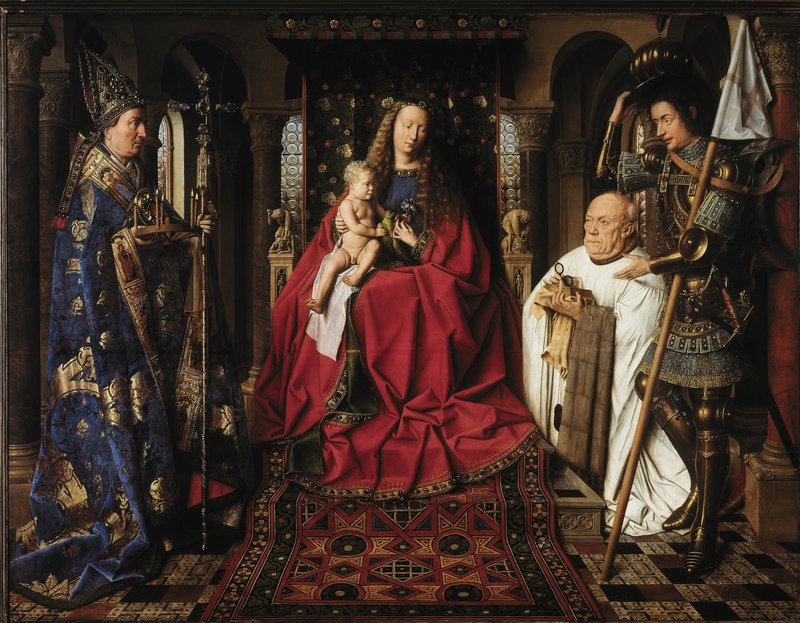
Belgium's supreme collection of Flemish Primitive and Flemish Renaissance painting, from Jan van Eyck and Rogier van der Weyden to Gerard David and Hugo van der Goes. The crown jewel is Van Eyck's Madonna of Canon van der Paele, completed in 1436 — one of the most technically perfect oil paintings in the world, made in Bruges and still here.
Two-hour local-led walk through medieval Bruges — the Burg, Markt, Belfry and Gruuthuse — with canal views and tastings of Belgian fries, chocolate and waffles along the way.
An insider storytelling walk through Bruges' secret alleys, glassy canals and ancient squares — the legends and scandals of the medieval city, with a chocolate-and-waffle bite en route.
A fairy-tale medieval walking tour led by white-umbrella guides who gather at the Belfry, weaving Bruges' history and folklore with a Belgian chocolate tasting.
Two-hour guided walk through Bruges' hidden corners and history with a chocolate tasting from a top chocolatier, then a scenic 35-minute canal cruise with reserved seating.
Passionate local storytellers bring Bruges' medieval history to life through tales, legends and local tips — no fixed route, guides adapt to the group and the questions you ask. A first-day essential.
A guided walk through Bruges' historic highlights — Markt, Burg, canals — combined with a visit to an artisanal chocolate shop to learn how pralines are made and a local brewery tour with beer tasting.
An authentic, interactive beer tour through Bruges with a passionate local guide — stories about Belgium's brewing world, tastings of craft and abbey beers, and a chocolate pairing at a top chocolatier.
A guided walk through medieval Bruges with a local, a 30-minute canal boat ride along the historic waterways, and an optional beer tasting at the end — a neat three-in-one introduction to the city.
Hands-on Belgian praline-making session at a dedicated workshop — participants craft their own filled chocolates from scratch, then round off the experience with a tasting of authentic Belgian craft beers. Recipes and a box of homemade pralines to take home included.
A lively 90-minute session where you taste three Belgian beers, pick your favourite to fold into the batter, then bake and eat your own Brussels waffles with all the toppings — a hands-on, unpretentious taste of Belgium at Hoogstraat 10.
A 100-minute food walk through Bruges led by a local volunteer — waffles, chocolate, fries, beer and the stories behind them, finishing with a complimentary beer at Bourgogne des Flandres Brewery overlooking the canal. Tips-based; fee covers platform costs only.
A 2.5-hour hands-on praline-making class in a dedicated chocolate workshop near the Markt — participants learn Belgian chocolate history, craft 30+ filled pralines per person and enjoy a hot chocolate tasting.
Taste three Belgian beers, select one to work into your batter, then bake and demolish your own Brussels waffle with classic toppings. A cheerful 90-minute session at Hoogstraat 10, run by knowledgeable and relaxed hosts.
A 30–40-minute guided canal cruise through the heart of Bruges aboard a covered group boat — the captain narrates in English, French and Dutch as you glide under stone bridges past guild houses, beguinages and weeping willows. A different perspective on the medieval city.
Bruges is Belgium's chocolate capital, with dozens of artisan chocolatiers hand-making pralines and ganaches. The filled praline was perfected in Belgium and remains the city's signature sweet.
Bruges brews its own Brugse Zot and Straffe Hendrik at the centuries-old De Halve Maan brewery, while classic beer cafés pour hundreds of Trappist and abbey ales.
Foreign number: accepted. — the code arrives by SMS on a foreign SIM, and an Uber login carries over without a second sign-up.
The smaller of the two delivery apps in Bruges, strongest for the chains and pizza places along the ring road; restaurant choice inside the old centre is limited and evening waits stretch past 45 minutes in summer, so order before the dinner rush.
Foreign number: accepted. — the account is email-based and the order confirmation goes by email; a phone number is asked for the courier but no SMS code has to arrive.
Belgium's biggest delivery platform, with the widest Bruges list — Flemish frituren, Turkish and Italian places, and most of the restaurants that deliver to the Katelijnestraat hotels; card and PayPal accepted, and the tracker is reliable.
Foreign number: not required. — sign-up runs on Google, Apple, Facebook or email with no phone field at all, so no verification code has to arrive.
The premium end of the three — the better restaurants around the Markt and Burg, a delivery-fee subscription that only pays off on a longer stay, and couriers on bikes that reach the car-free core faster than the others.
Bruges' landmark concert hall, opened in 2002: a 1,289-seat auditorium famed for its acoustics, with classical, contemporary and world-music programmes.
Foreign number: accepted. — the verification code arrives by SMS on a foreign SIM, and an existing Uber account signs straight in.
Thin in Bruges: a handful of cars at most, usually waiting near the station and the ring road, and none inside the car-free core where most of the guide walks anyway. Useful for the station run with luggage or a late return from a day trip; at the Markt the taxi rank is faster.
The nearest North Sea resort: a long sandy beach, a breezy promenade and a celebrated modern-art museum — a quick sea-air escape barely 15 minutes by train.
Bruges' larger medieval sister: the towering St Bavo's Cathedral holds the Ghent Altarpiece, while Gravensteen castle and the Graslei waterfront line the river Leie. Direct trains run several times an hour.
The Flemish city destroyed and rebuilt after WWI, with the reconstructed Gothic Lakenhalle and Menin Gate — a memorial arch covered top-to-bottom in the names of 54,896 missing Commonwealth soldiers — and the In Flanders Fields Museum inside the Cloth Hall.
Bruges looks perfectly medieval for a melancholy reason. In the 15th and 16th centuries the Zwin estuary that linked the city to the sea silted up, strangling the trade that had made Bruges one of the richest cities in Europe. The money left, the cranes fell silent, and for three centuries Bruges was too poor to tear anything down or build anything new. That long sleep is exactly why its canals, guild houses and church towers survive intact today — the 19th-century writers who called it "Bruges-la-Morte" were unwittingly describing the best-preserved medieval city in Europe.
The swans you will see on the canals at Minnewater are there by decree. When the citizens of Bruges executed a hated administrator of Maximilian of Austria named Pieter Lanchals — whose family emblem was a long-necked white bird — Maximilian is said to have ordered the city to keep swans on its waters forever in his memory. More than five hundred years later, they are still gliding under the bridges.